Museum Tour / The Great Diversification
Deep Time Spine

The Great Diversification

The Ordovician Period · 485 – 444 m.y.a.

Play the scene with narration and quiet underwater ambience. Marine reconstructions are interpretive. AI-animated concept visualization. View the original image.

Film transcript

[Quiet underwater ambience] After the Cambrian, Ordovician seas grew richer with life. Straight-shelled cephalopods cruised overhead. Sea lilies and brachiopods crowded the seafloor. As new habitats and feeding roles spread, ocean communities grew more complex. Walk into this vanished world at TROIS MUSEUM. [Ambience gently fades]

Working Concept Plan

The experience this room is designed to create

Across millions of years, Ordovician seas grew richer with straight-shelled cephalopods, stalked echinoderms, brachiopods, and expanding reefs. Near the period’s end, a major extinction reshaped marine life.

Translate The Great Diversification into a legible, embodied chapter of planetary history while keeping scientific evidence and visual reconstruction clearly distinguished.

Planning statusThis page is a directional design brief, not a finalized curatorial, architectural, or construction commitment. It will evolve through scholarly, community, accessibility, conservation, and design review.
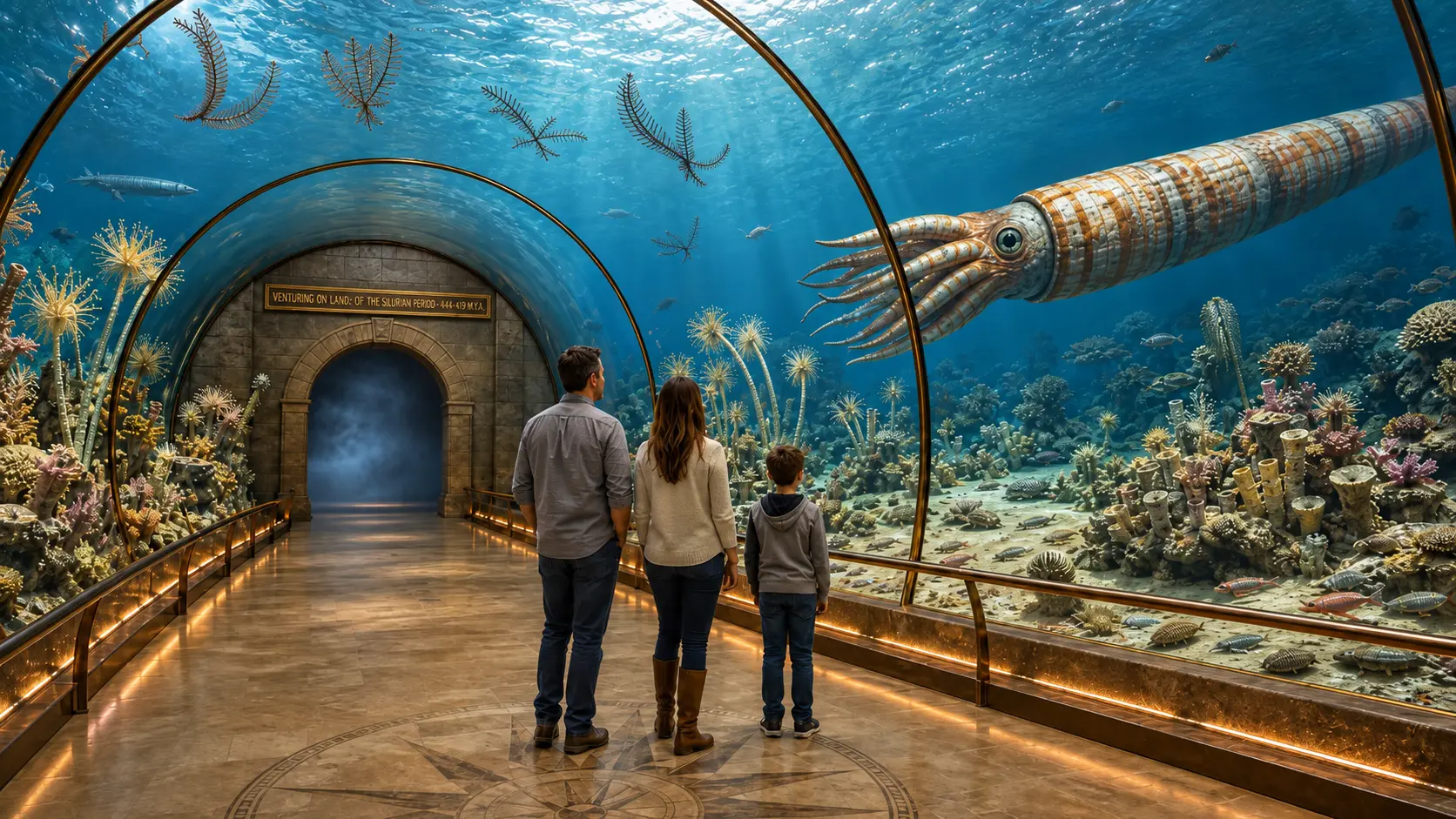
Experience Framework

How the plan unfolds

01

Visitor journey

  • Approach through a threshold that establishes the time scale of The Ordovician Period · 485 – 444 m.y.a..
  • Encounter the central environmental change or living system at human scale.
  • Close with one clear consequence that carries visitors toward the next room.
02

Spatial & atmospheric plan

  • Use landscape-scale imagery, material samples, and directional sound without obscuring the evidence.
  • Balance cinematic immersion with readable labels, resting points, and a low-sensory route.
  • Keep the passage to the next room visible so the spine reads as one continuous story.
03

Interpretive commitments

  • Separate verified evidence, interpretation, and artistic reconstruction in the label hierarchy.
  • Review language and object context with relevant scholars and affected communities.
  • Provide captions, transcripts, tactile or descriptive alternatives, and a low-sensory path.
04

Next development priorities

  • Confirm the curatorial thesis and source packet.
  • Identify anchor objects, replicas, media, and rights requirements.
  • Prototype the central visitor encounter at full or representative scale.
  • Complete accessibility, conservation, safety, and ethical-display reviews.

Continue through the complete civilizational arc, or join the conversation shaping what these rooms become.