Step into a story born of fire, time, and wonder
The Trois Museum begins with the first fifty rooms — an introductory spine that carries visitors across 4.5 billion years, from the molten Earth to the present day. These rooms prepare you for everything else inside.
Beyond the spine, more than one hundred additional rooms branch across three floors — filled with the artwork, antiquities, and curated worlds Charles has gathered over more than fifty years. And beyond those, at the sacred heart of the museum, lies the Wing where the experience of the visitor truly begins.
In the beginning, whatever you believe about how the world began, you are welcome here. Life’s mystery predates every theory of it.
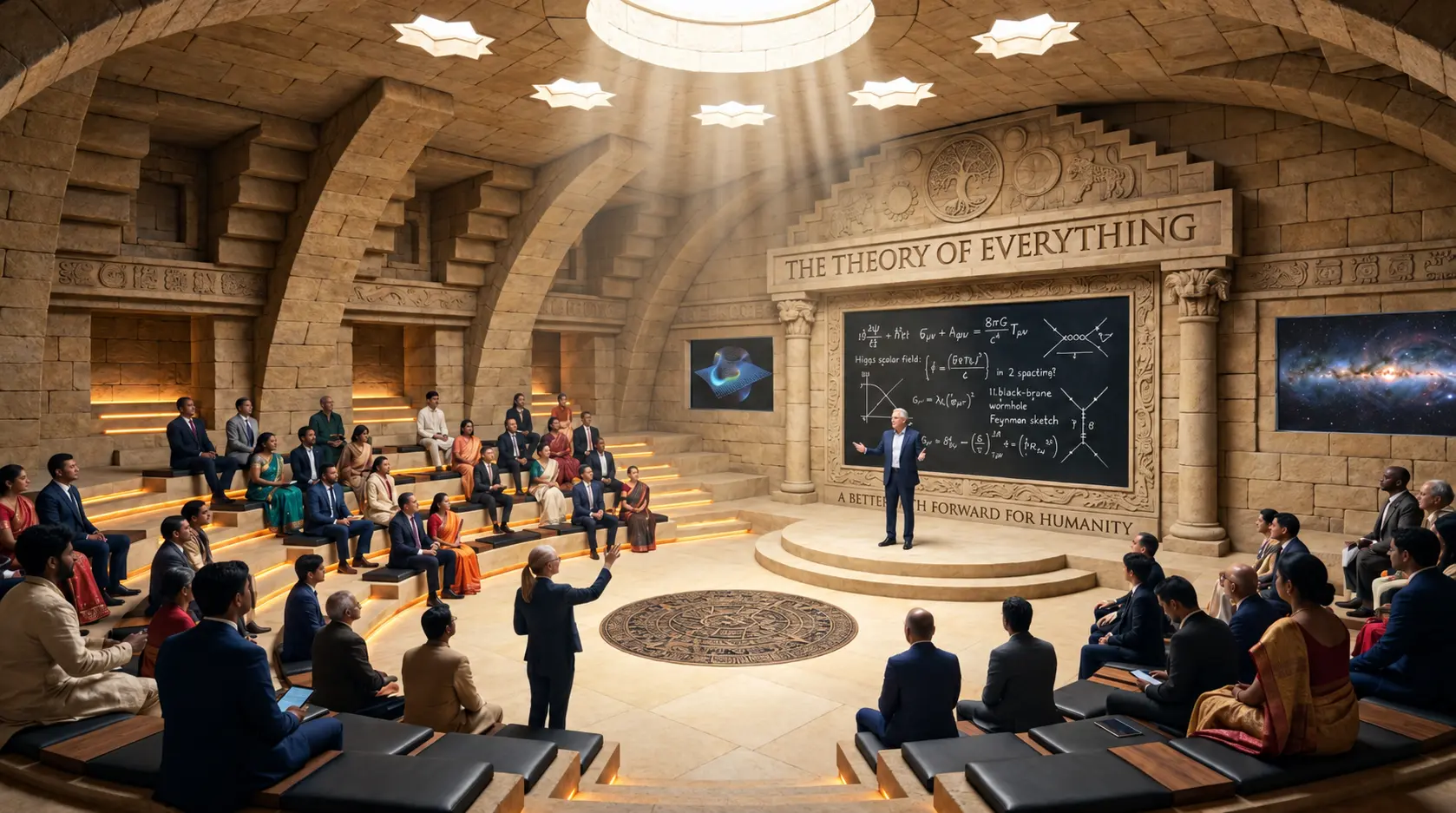
Where the Theory of Everything Meets a Better Path Forward for Humanity
At the sacred heart of the Trois Museum lies the Theory of Everything Wing — the place where the educational journey of the spine becomes a living practice. At its center is the Collaborative Hemicycle: a curved chamber, drawn from the architectural lineage of humanity’s great deliberative spaces, designed for the world’s most consequential conversations and crowned by an oculus open to the cosmos.
Here, beneath that open sky, Charles Trois convenes heads of state, visionary leaders, scientists, builders, artists, and the keepers of ancient wisdom — in pursuit of a shared picture of the future. Around the Collaborative Hemicycle, the deepest laws of the universe and the wisest choices for humanity converge as a single, living blueprint for the civilization to come.
Read the Theory of Everything Wing planFive Questions, Older Than Every Civilization
“Why are we here?”
“What are we supposed to be doing with the time we have?”
“How are we supposed to treat one another?”
“What do we owe the living — and what do we owe the dead?”
“What kind of world are we obligated to leave behind?”
These are not new questions. They appear on cave walls and cathedral ceilings, in the laws of ancient empires and the songs of people with no written language at all. Every civilization has wrestled with them. None has finished.
The Trois Museum traces that wrestling — from the first sparks of life on Earth, through the choices that face us today, and into the world we will build together.
Made orbital rockets reusable, the electric car ordinary, and a single-planet species optional.
Built the silicon foundry the entire age of AI runs on.
Built the AI that solved a 50-year problem in biology.
Invented the neural networks that taught machines to see, and gave the world open-source frontier AI.
Built a frontier AI lab where safety is the architecture, not the afterthought.
Gave humanity the first tool to rewrite the code of life.
Made mRNA speak our cells’ language — and changed medicine forever.
Invented the Web — and gave it to the world royalty-free.
Invented the quantum computer — as something you can actually build.
Taught machines to see — and lit the spark of the modern AI revolution.
The First Fifty+ Rooms — From the Birth of Earth to the Future
Every gallery on the spine corresponds to a chapter in this arc. Each room is not merely history — it is a space you walk through, an atmosphere you inhabit, a question you carry with you as you move to the next.
And when the fifty+ are complete, the museum truly begins.
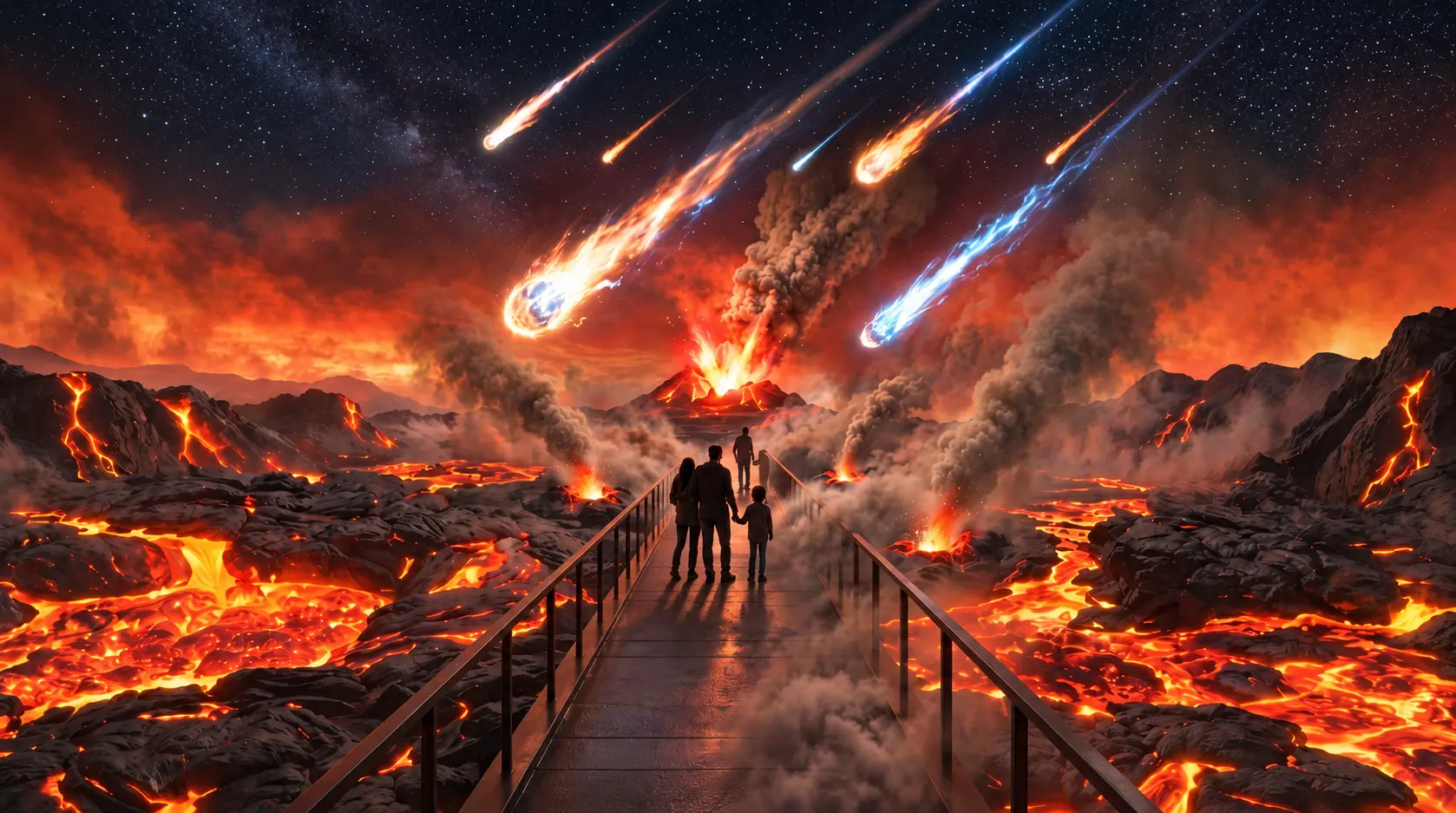
Birth of Earth
The Hadean Period · 4,500 – 3,800 m.y.
A molten world bombarded by meteorites, with no land and no life — only fire, gas, and the violent possibility of everything that would follow.
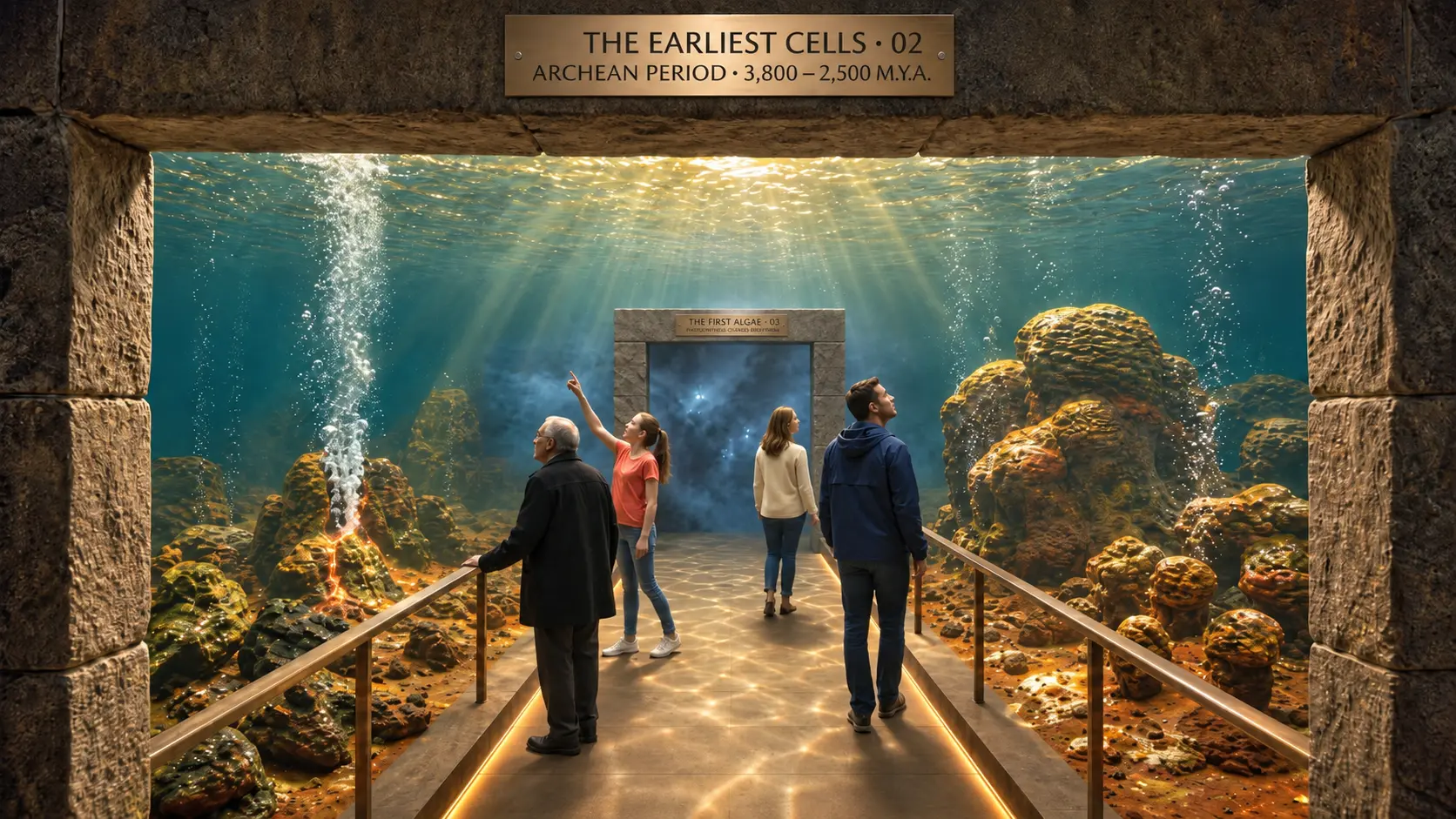
The Earliest Cells
The Archean Period · 3,800 – 2,500 m.y.
Life stirs in ancient seas. Stromatolites — microbial mats — become the planet's first architects, breathing oxygen into a sky that had none.
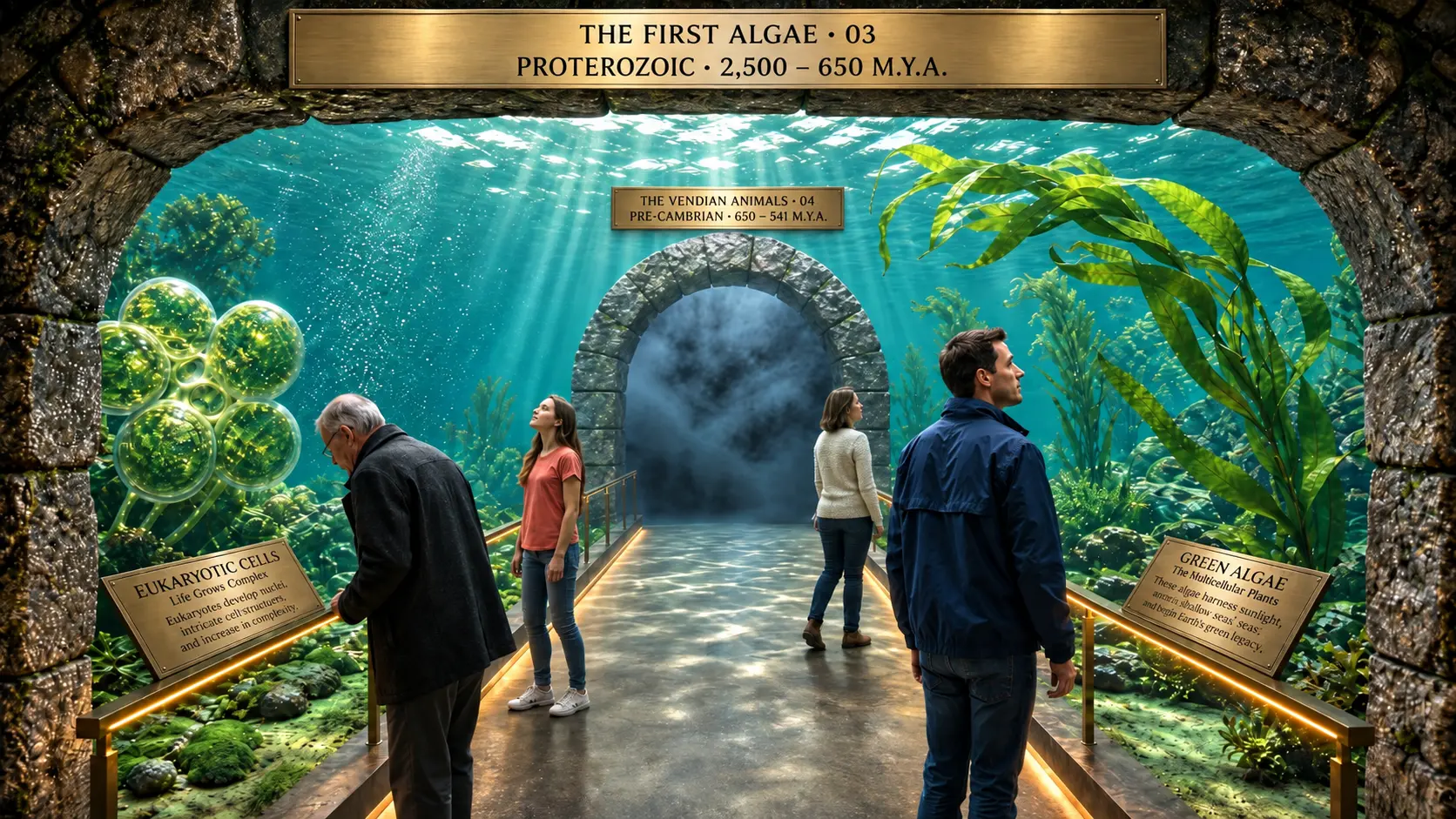
The First Algae
The Proterozoic · 2,500 – 720 m.y.a.
For nearly two billion years, single cells folded inward to cradle the first nuclei, oxygen turned from poison to promise, and vast blooms of algae painted the oceans green — a planet learning how to host itself.
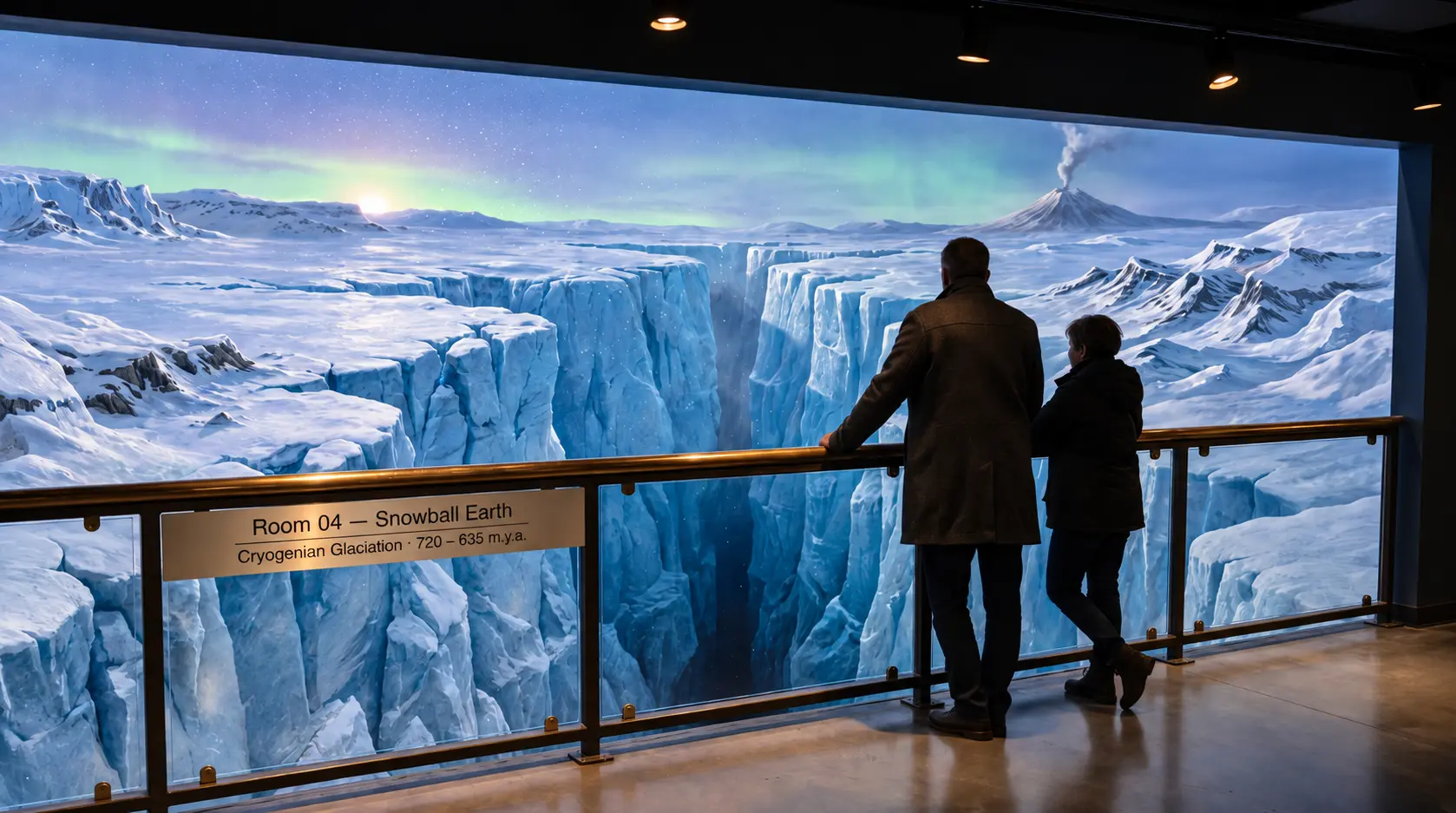
Snowball Earth
The Cryogenian · 720 – 635 m.y.a.
Between the green oceans and the first dreaming animals, the Earth froze. Ice climbed down from the poles until it kissed the equator, sealing the seas beneath a 2 mile roof of ice.
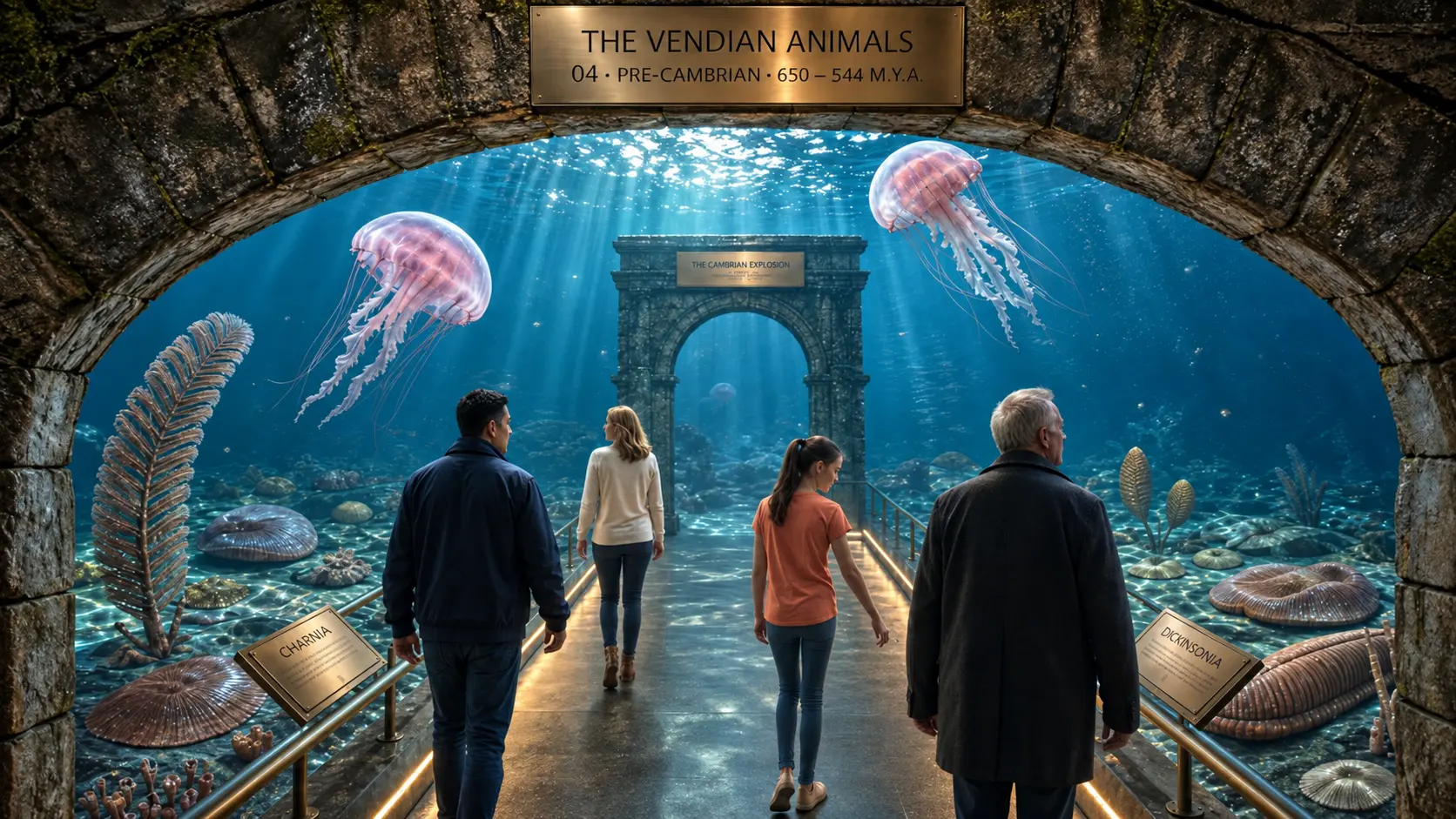
The Vendian Animals
The Pre Cambrian · 635 – 541 m.y.a.
In the late Precambrian, soft-bodied organisms spread across ancient seafloors. Frond-like Charnia and quilted Dickinsonia left impressions that offer clues to the early evolution of animals.
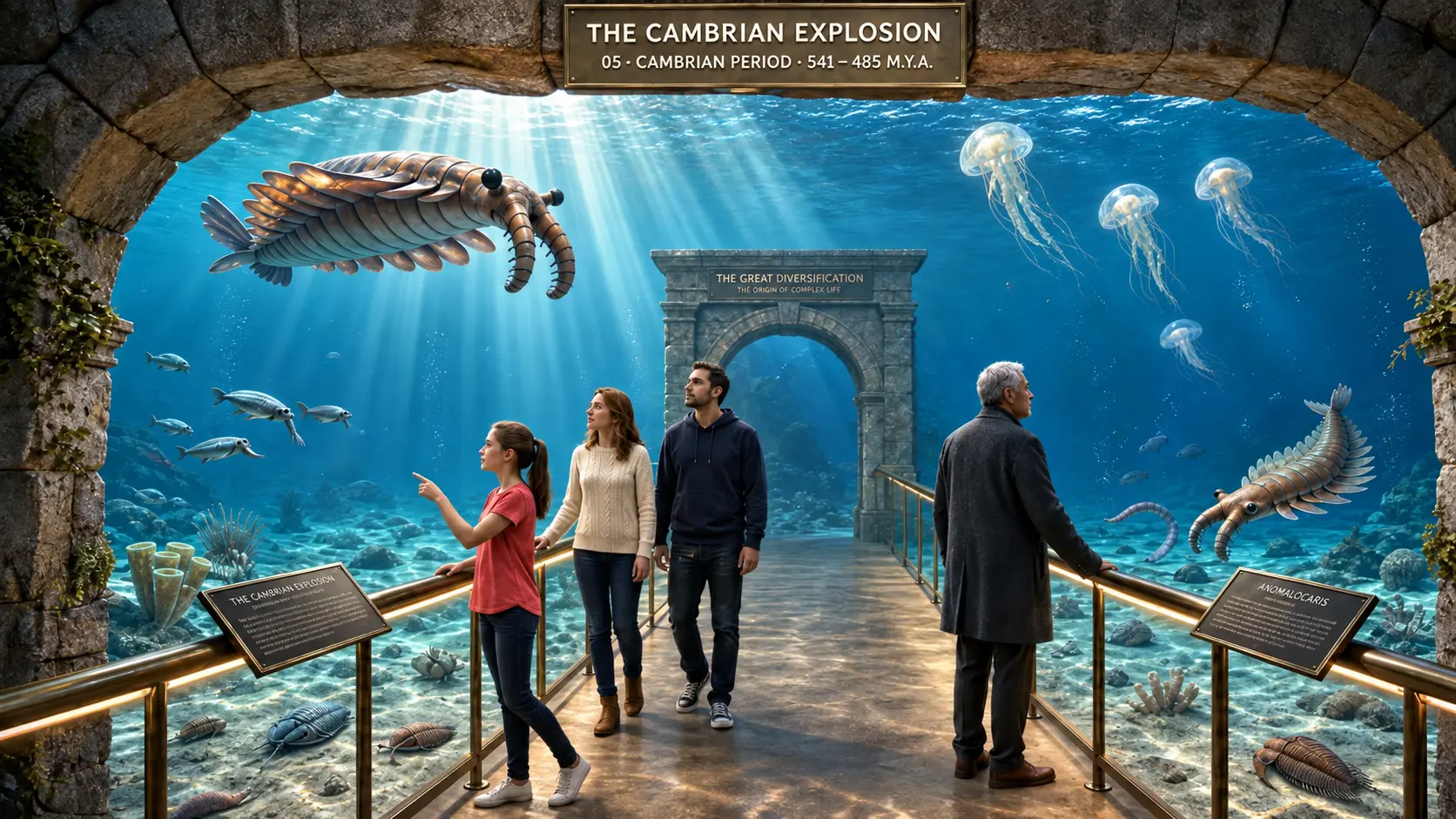
The Cambrian Explosion
The Cambrian Period · 541 – 485 m.y.a.
Across millions of years, Cambrian seas saw a rapid diversification of animal life. Trilobites and other arthropods spread, while new ways of seeing, feeding, and defense transformed ocean ecosystems.
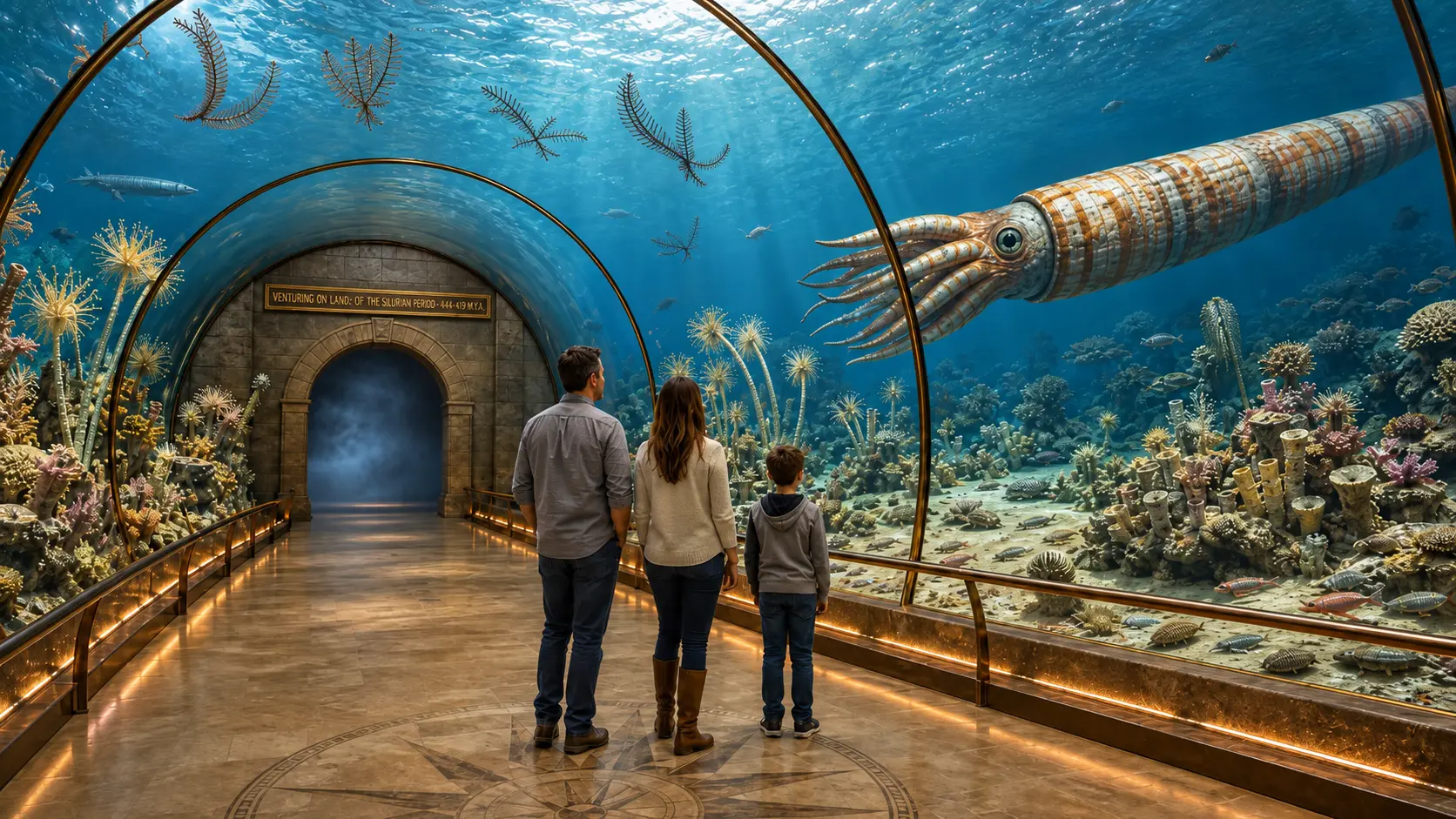
The Great Diversification
The Ordovician Period · 485 – 444 m.y.a.
Across millions of years, Ordovician seas grew richer with straight-shelled cephalopods, stalked echinoderms, brachiopods, and expanding reefs. Near the period’s end, a major extinction reshaped marine life.
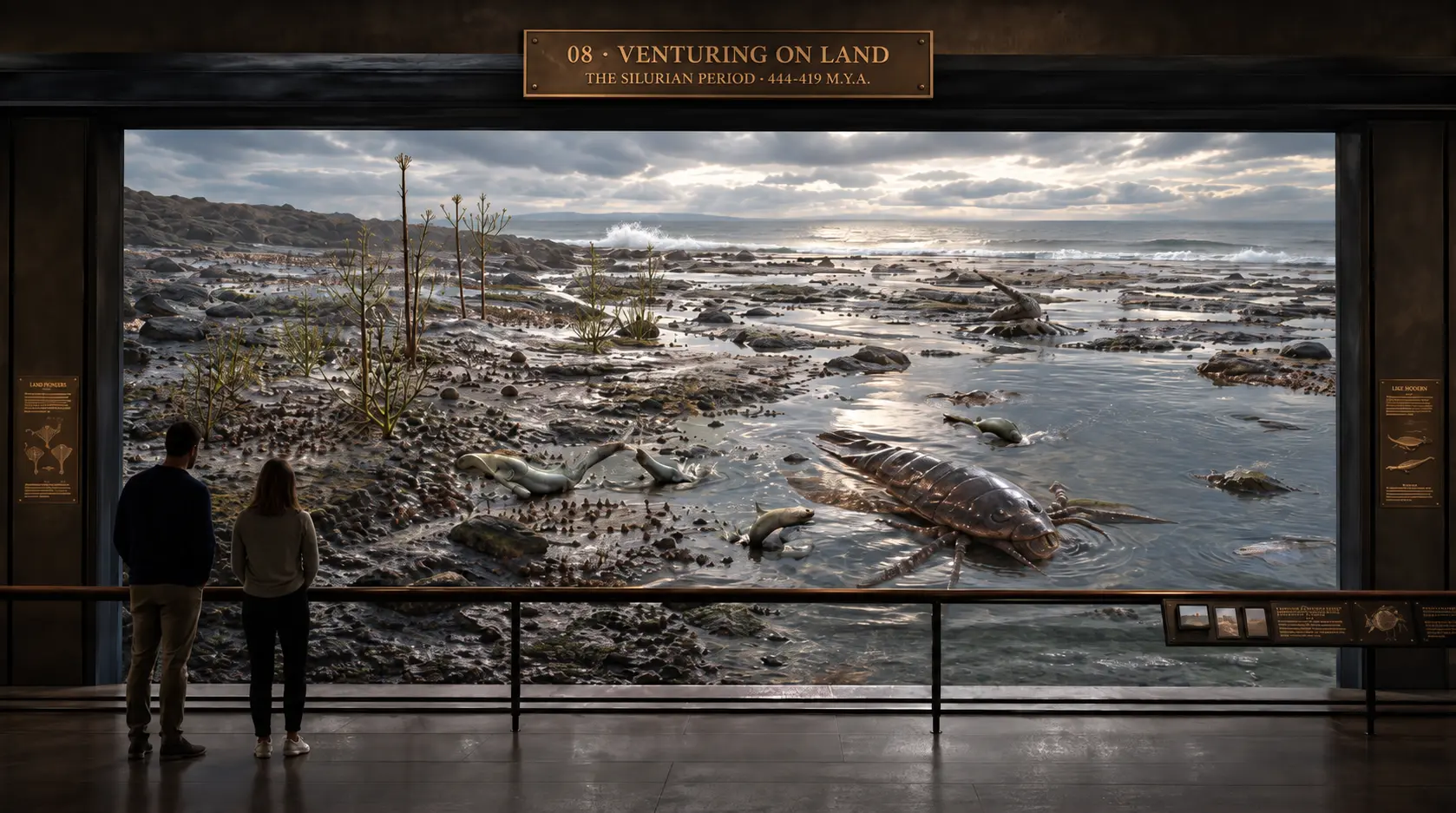
Venturing on Land
The Silurian Period · 444 – 419 m.y.a.
Along Silurian shores, small plants and arthropods began establishing life on damp land. In the shallows, marine animals still thrived. This room explores the boundary where new land habitats opened beside the sea.
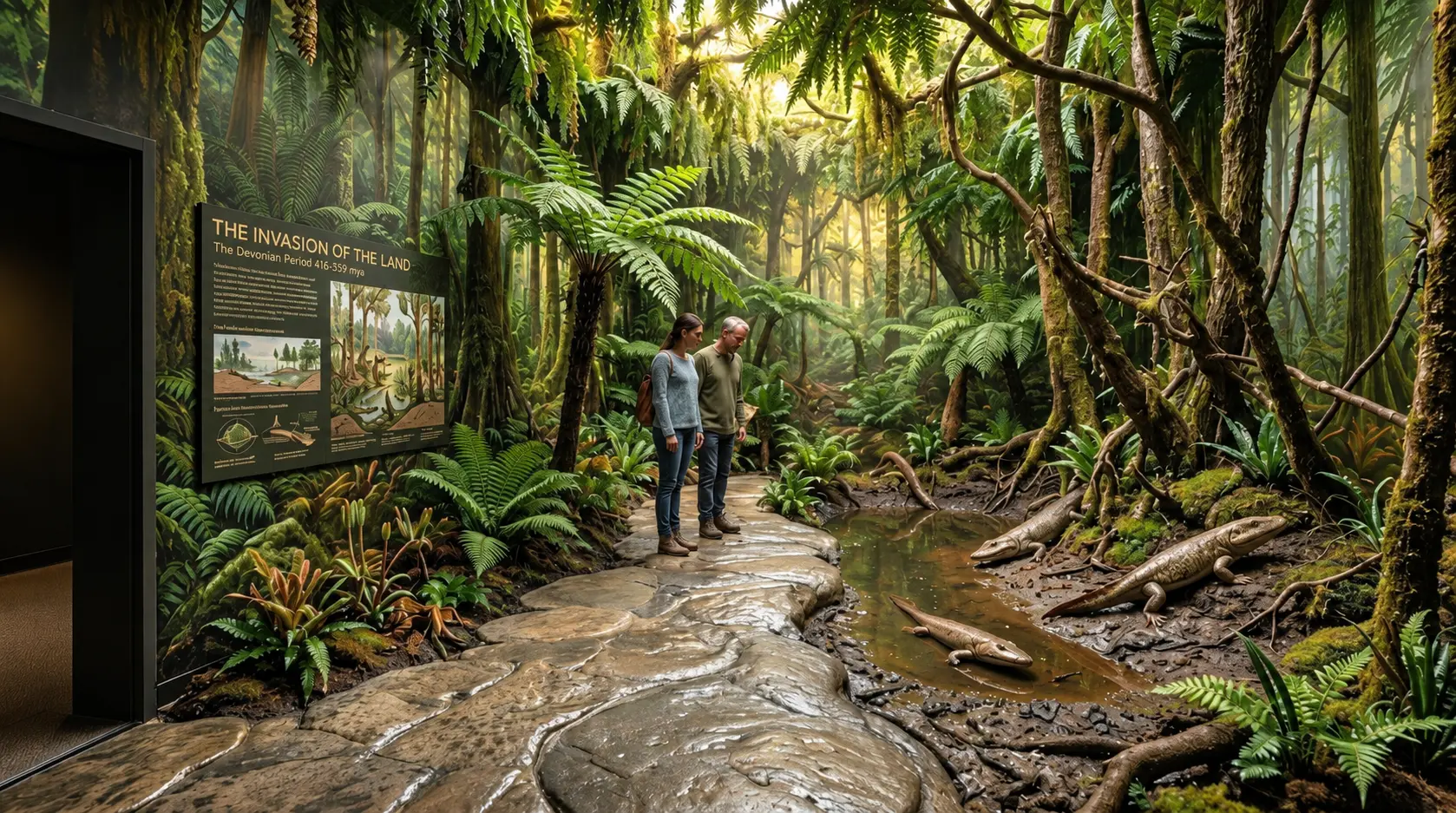
Invasion of the Land
The Devonian Period · 419 – 359 m.y.a.
Forests spread across continents. Fish become amphibians. The first seeds scatter on the wind. The land is claimed by living things that never imagined returning to the sea.
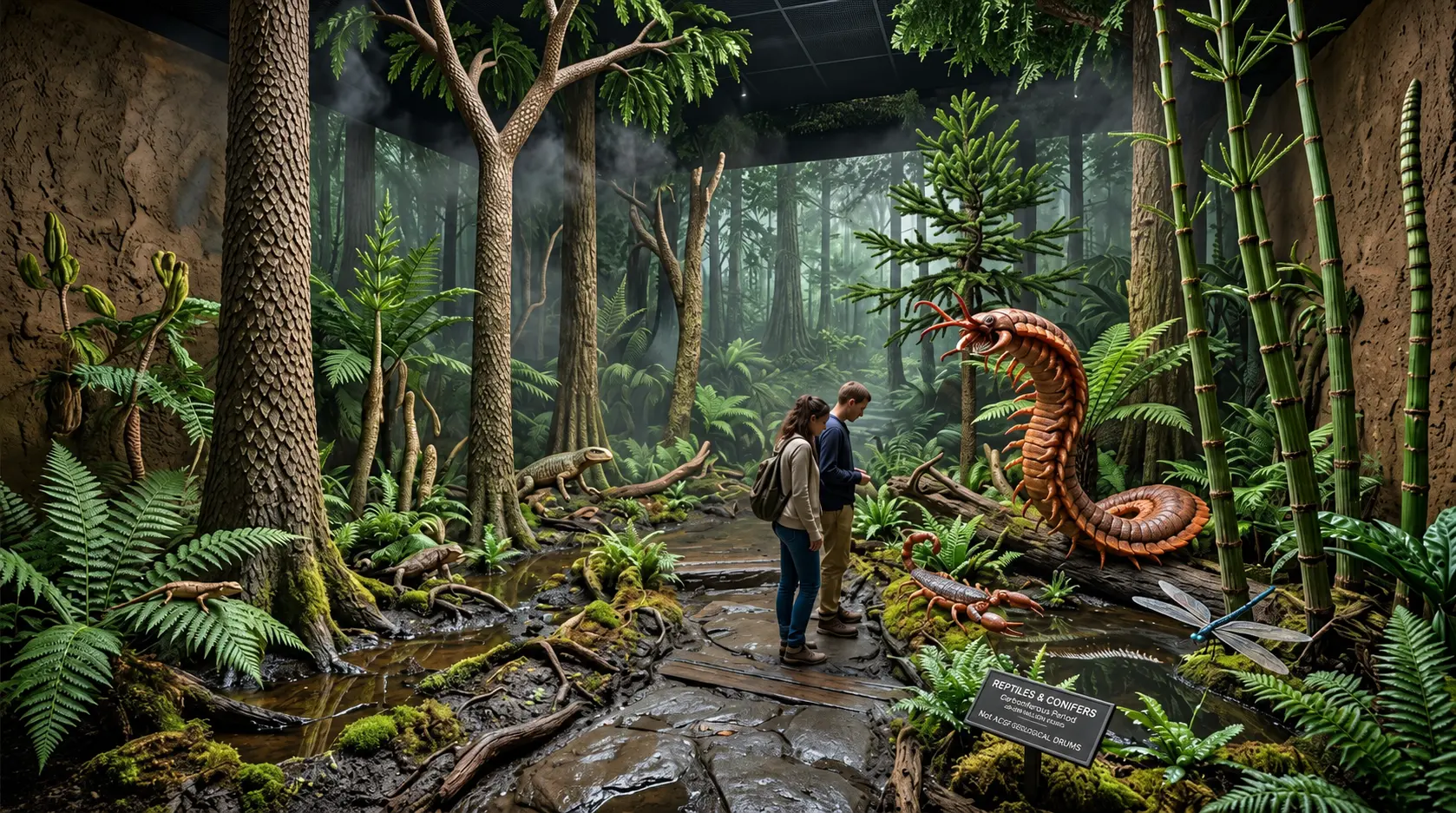
The Age of Giants
The Carboniferous Period · 359 – 299 m.y.a.
The air itself is different — thick with 35% oxygen. Vast swamp forests dominate the Earth. Insects invent flight and grow to the size of hawks. Eight-foot millipedes prowl the forest floor. Reptiles lay the first waterproof eggs. Life becomes independent of water — and the coal that will fuel our industrial age begins to form.
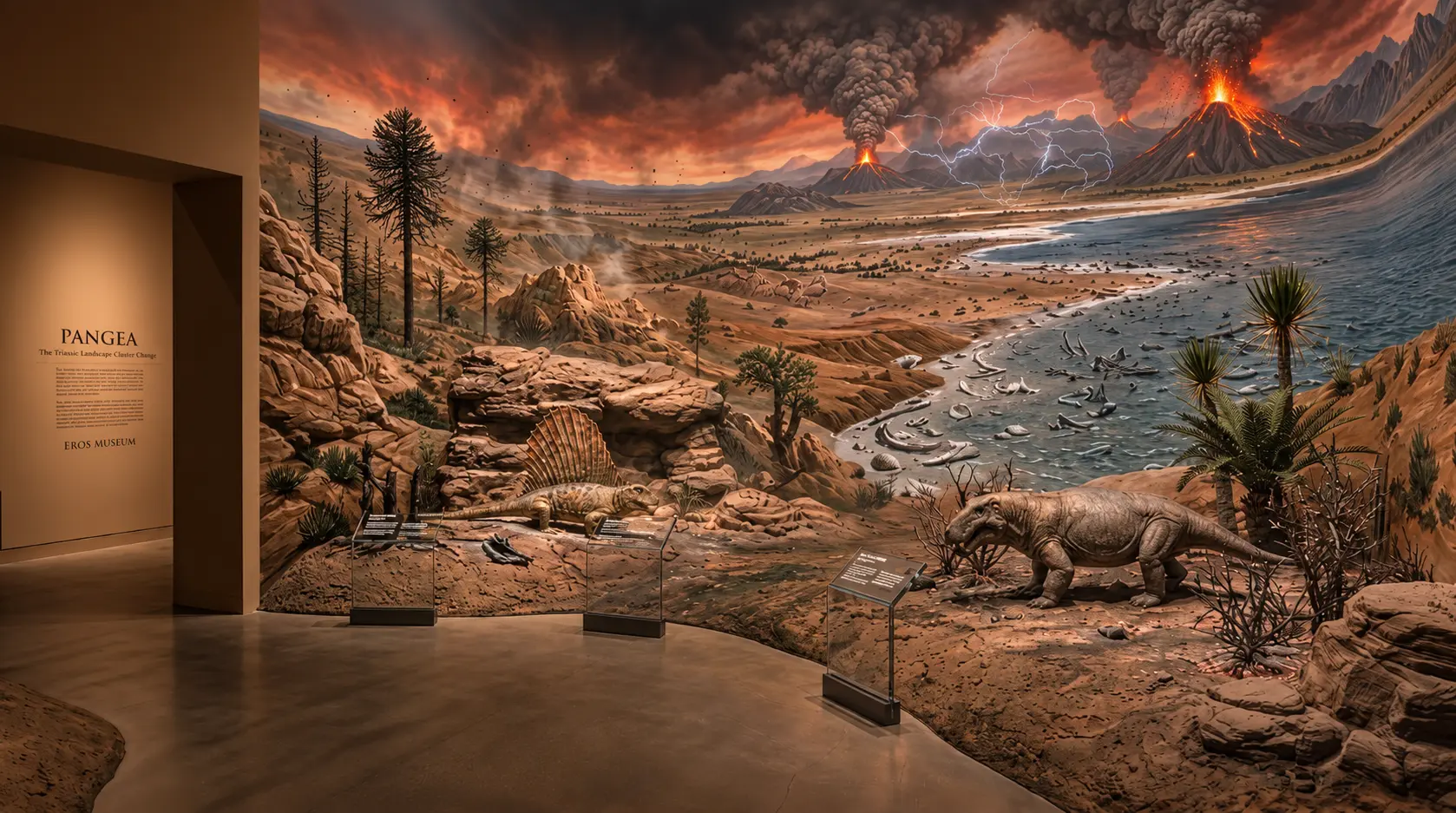
Pangea
The Permian Period · 299 – 252 m.y.a.
All continents fuse into one vast supercontinent. The world is warm, dry, and dominated by reptiles, seed ferns, and the first proto-mammals.
Then volcanoes in Siberia ignite buried coal. Carbon floods the atmosphere. The oceans warm, acidify, and lose their oxygen. Hydrogen sulfide poisons the seas and the sky.
This is the Great Dying — the largest extinction in Earth’s history, erasing over 90% of all species. The world rebuilds from almost nothing.
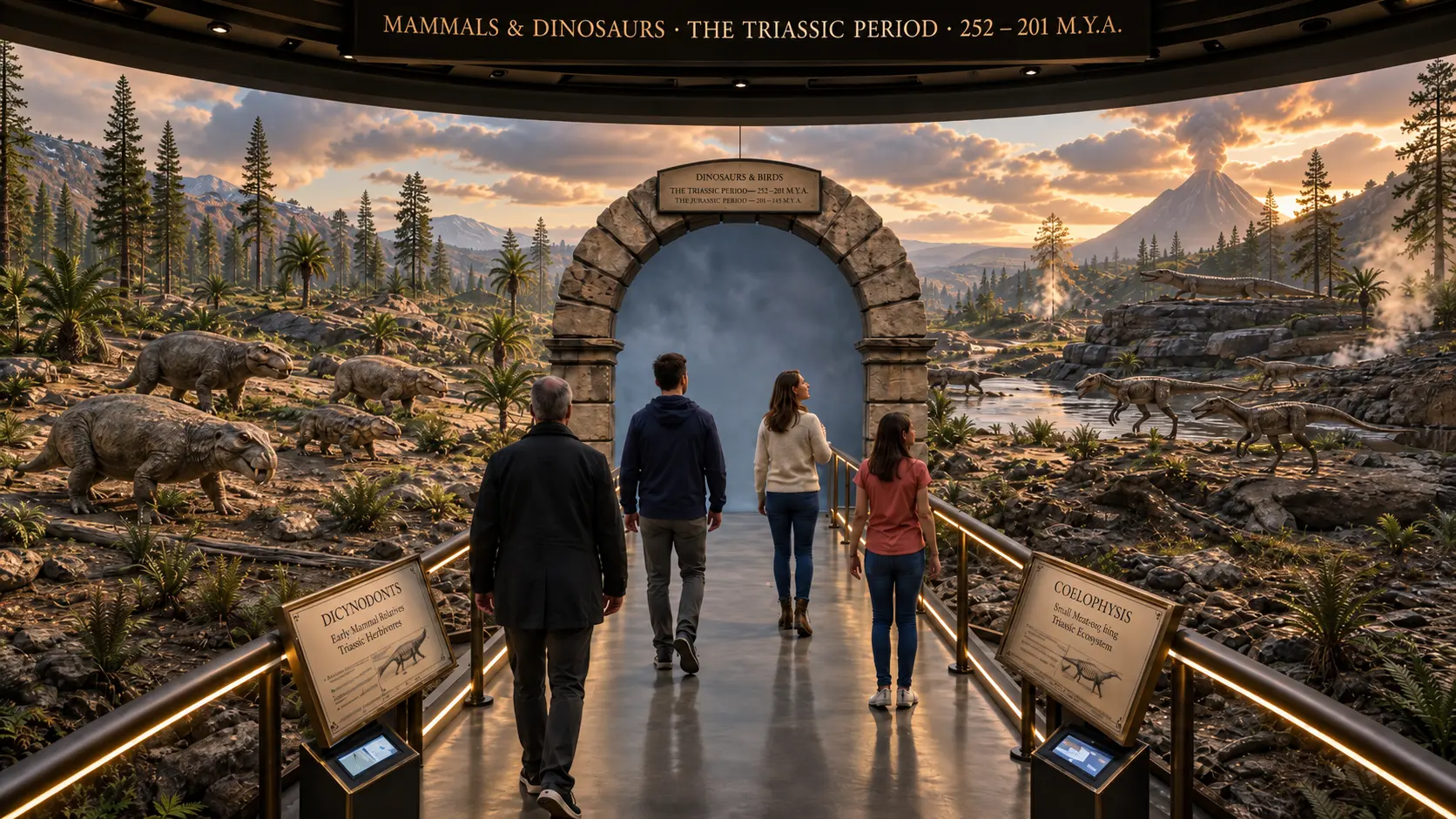
Dinosaurs & Small Mammals
The Triassic Period · 252 – 201 m.y.a.
From the ash of mass extinction, two great lineages rise side by side. The dinosaurs grow swift, fierce, and enormous — destined to rule the Earth for 165 million years. The first mammals stay small, warm, and watchful — destined to inherit it.
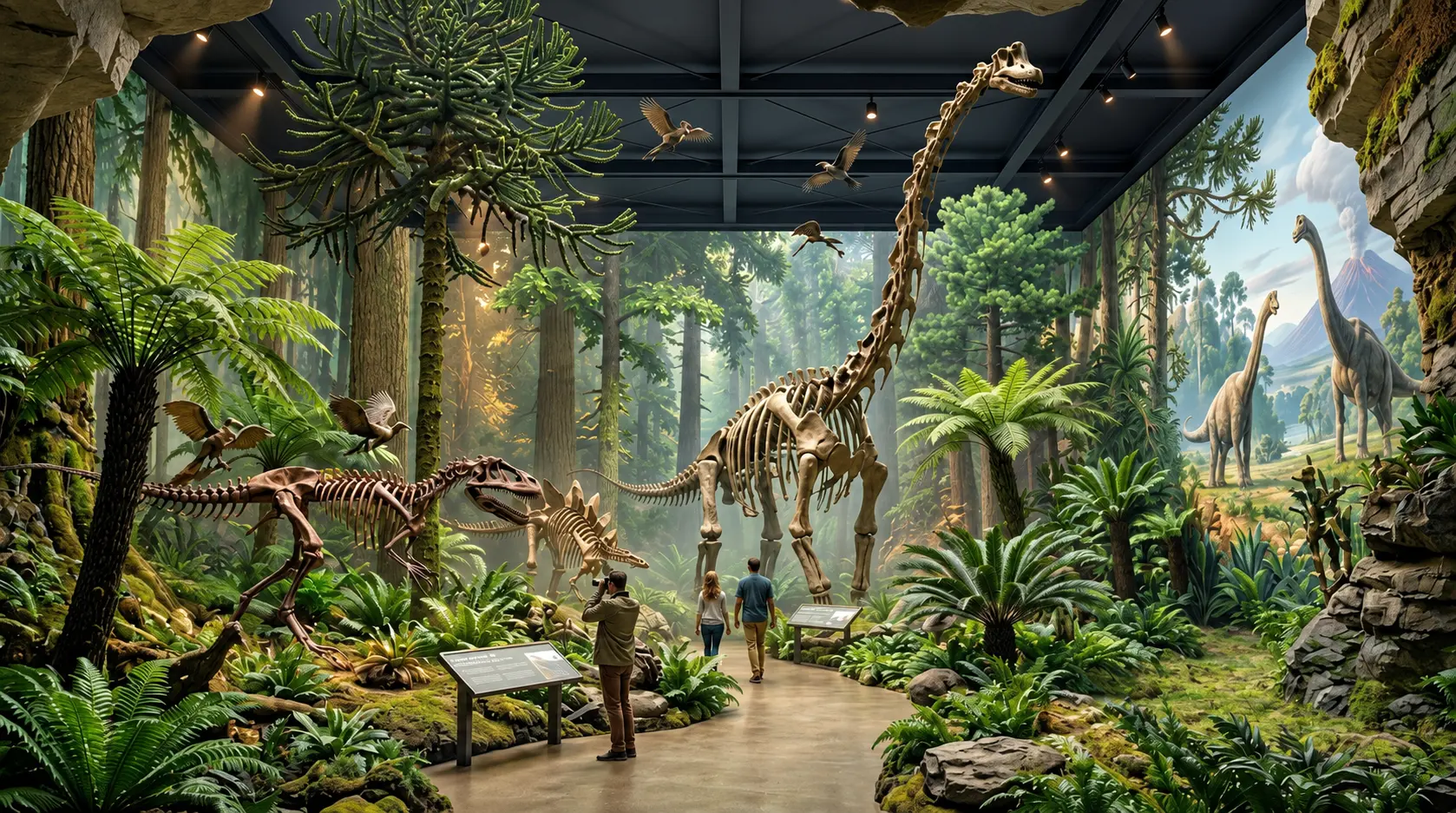
Dinosaurs & Birds
The Jurassic Period · 201 – 145 m.y.a.
Giants walk the Earth. The first birds take flight from feathered dinosaur ancestors. Flowering plants have not yet arrived — the world is still ancient and green.
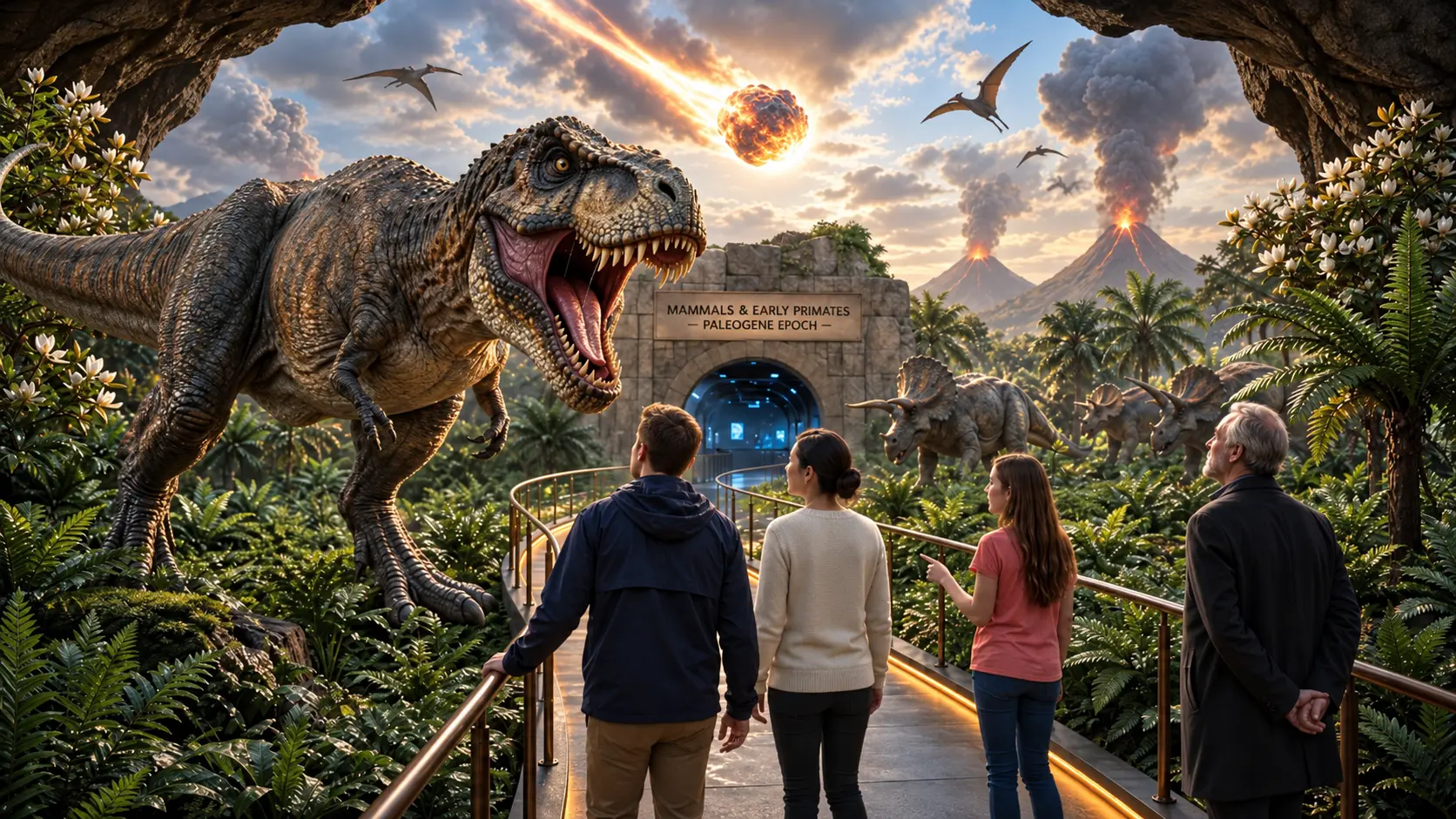
The Final Season of the Dinosaurs
The Cretaceous Period · 145 – 66 m.y.a.
Flowers bloom. Bees appear. Then a seven-mile asteroid ends 75% of all species in a single event — and the age of mammals quietly begins in the rubble.
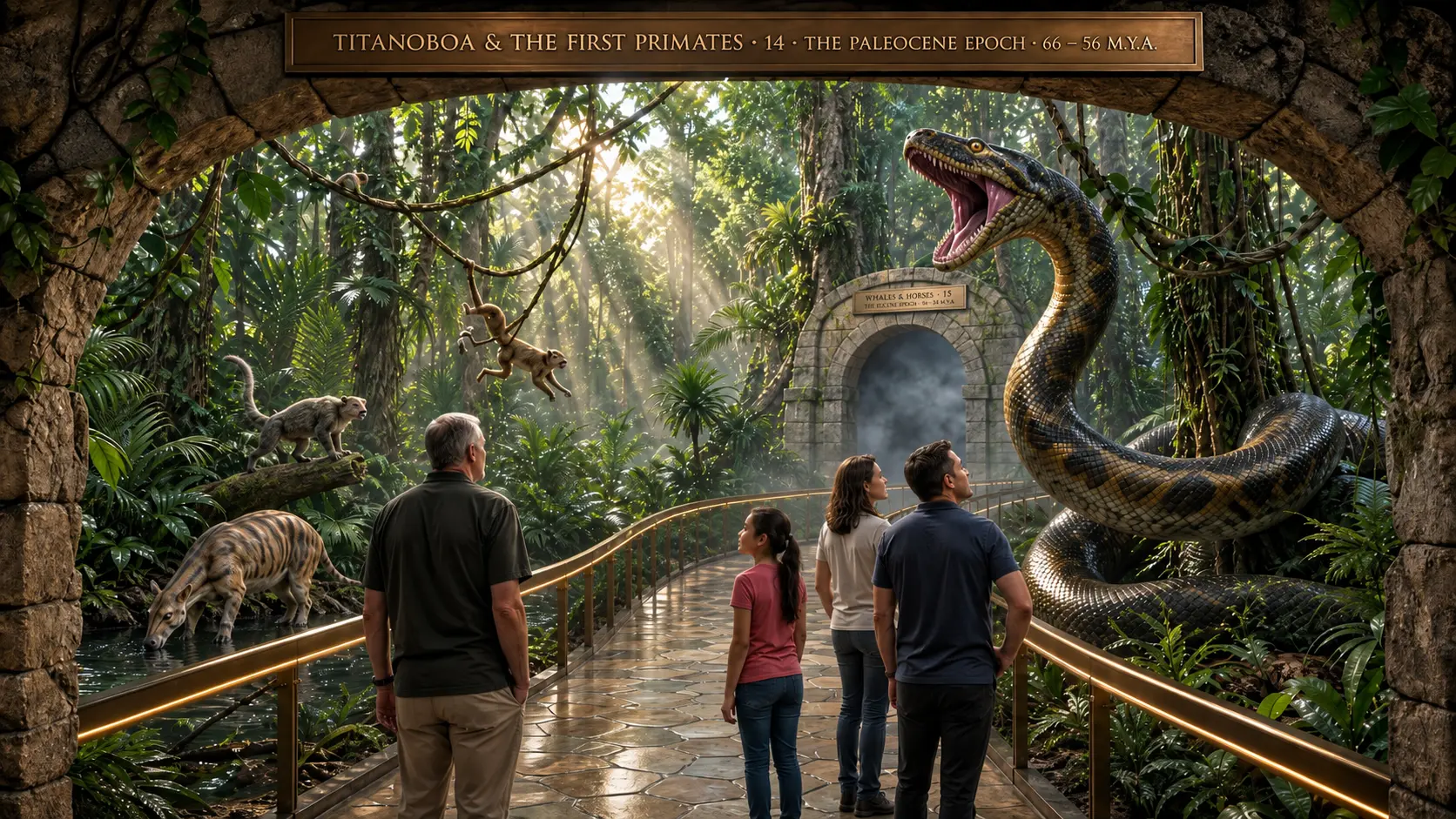
Titanoboa & the First Primates
The Paleocene Epoch · 66 – 56 m.y.a.
In the steaming rainforests after the asteroid, a 60-foot snake rules the jungle floor. Giant turtles drift through the rivers. Crocodile cousins prowl the swamps. And high in the canopy — small, intelligent, watchful — the primate branch takes its first tentative steps toward the creature that will one day ask: Why are we here?
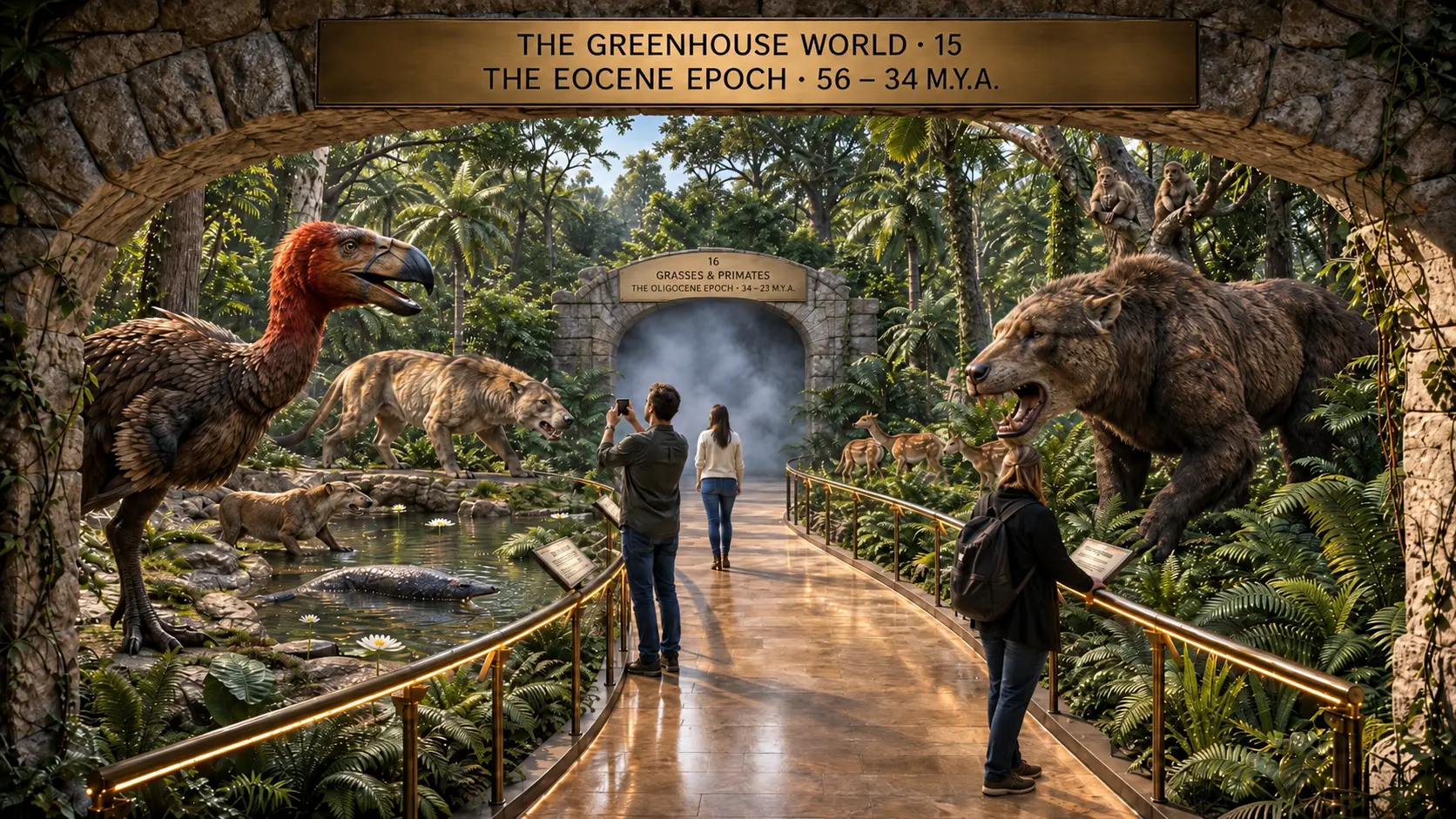
The Greenhouse World
The Eocene Epoch · 56 – 34 m.y.a.
Earth is hot, wet, and ruled by strangers. Terror birds — ten feet tall, hooked beaks the size of horse skulls — chase prey across forested plains. Six-horned rhinos with saber-teeth crash through warm subtropical canopies. In the sea, land mammals become whales. In the night sky, bats become the first flying mammals. The world is experimenting with every shape life can take.
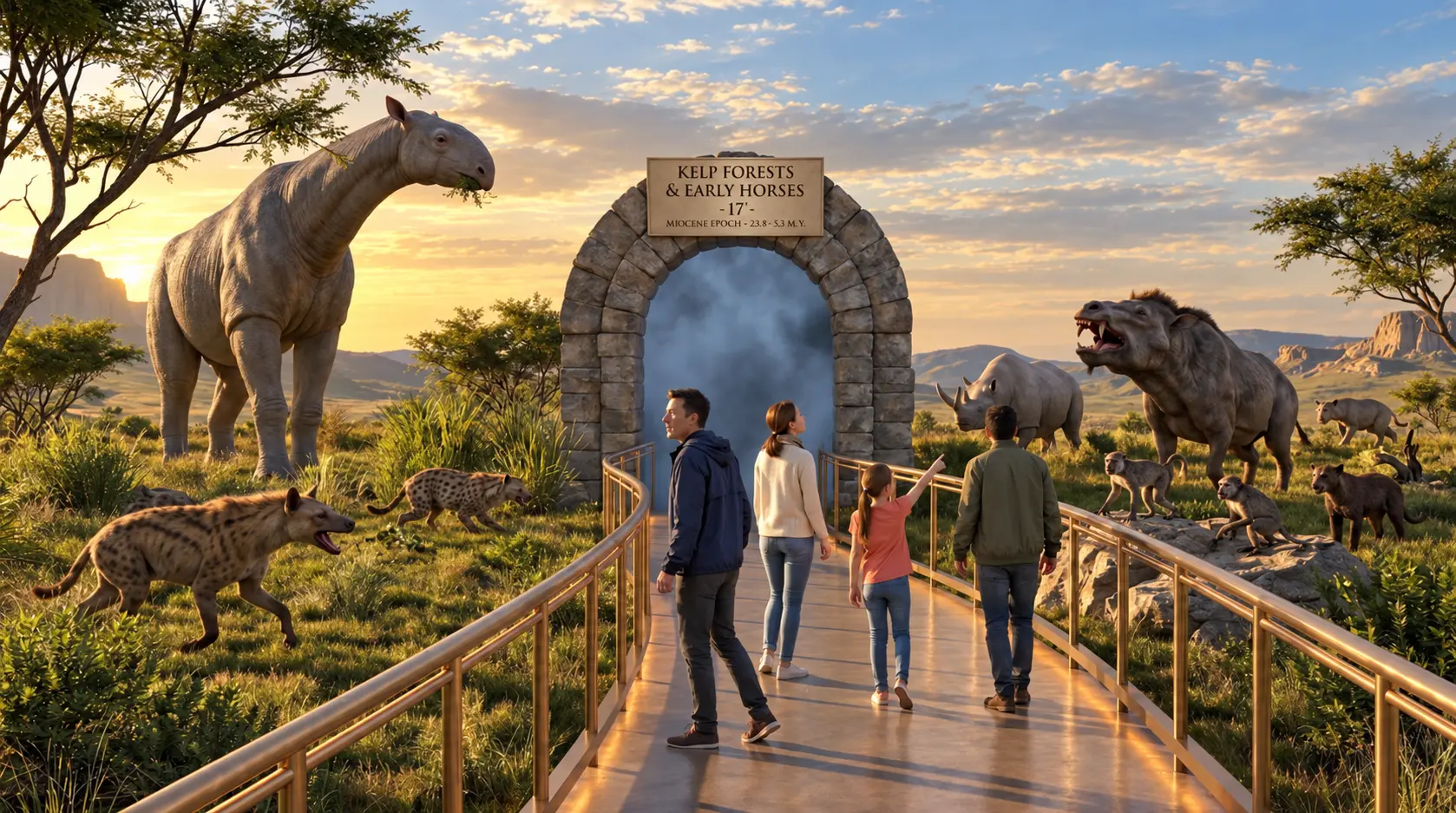
Grasses & Primates
The Oligocene Epoch · 34 – 23 m.y.a.
The world cools. Grasslands take root. Primates grow more complex. The great savanna stage is being set — and in the wings, something is beginning to stand upright.
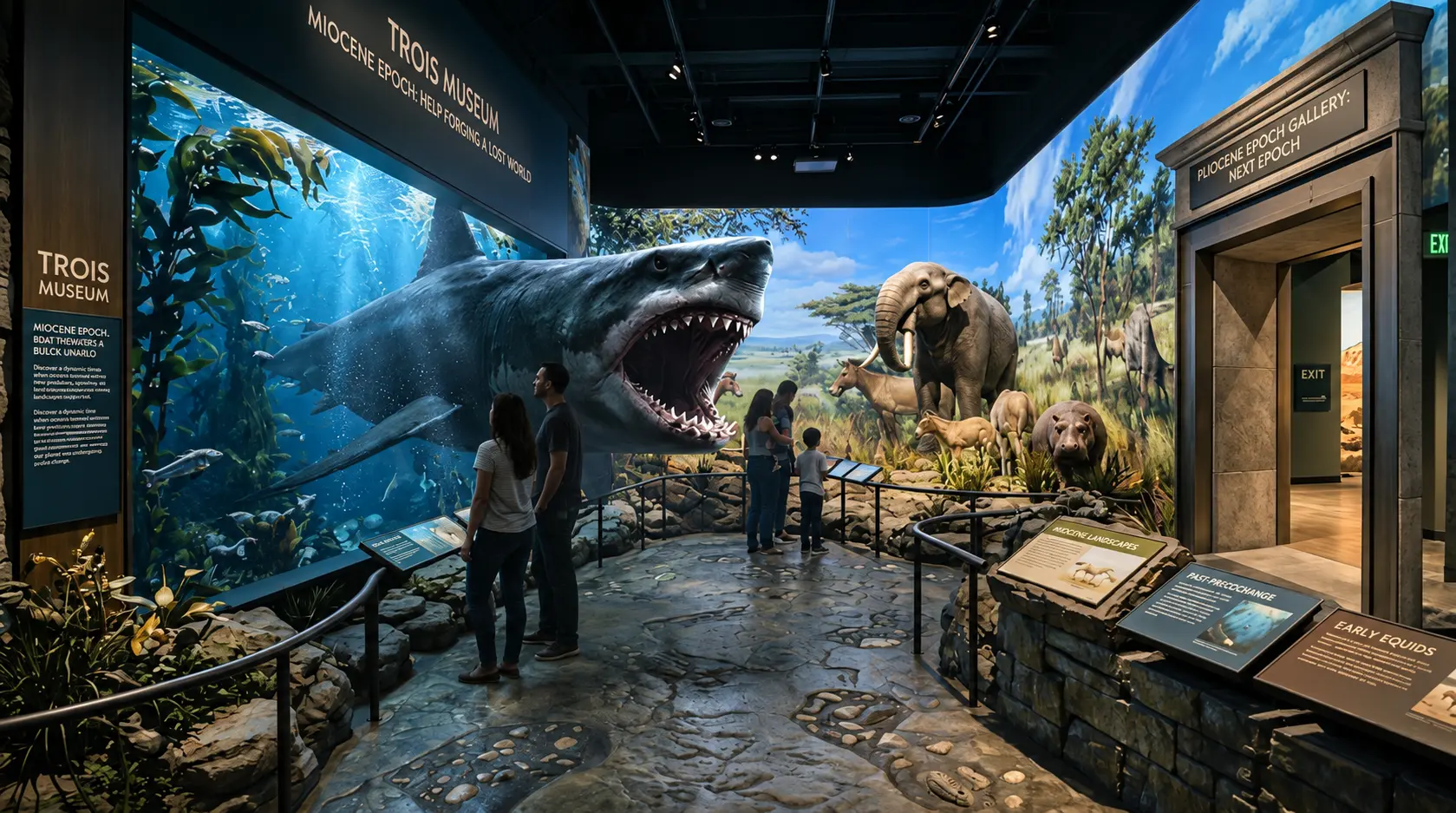
Megalodon & Apes
The Miocene Epoch · 23 – 5.3 m.y.a.
In the oceans, the largest shark that has ever lived patrols the seas — Megalodon, 80 feet long, hunting whales. On land, bear-dogs and twin-tusked elephants roam three continents. Grasslands spread for the first time. Kelp forests sway in newly cool seas. And in the forests of East Africa, the apes diverge — the lineages of orangutans, gorillas, chimpanzees, and the still-unwritten story of us.
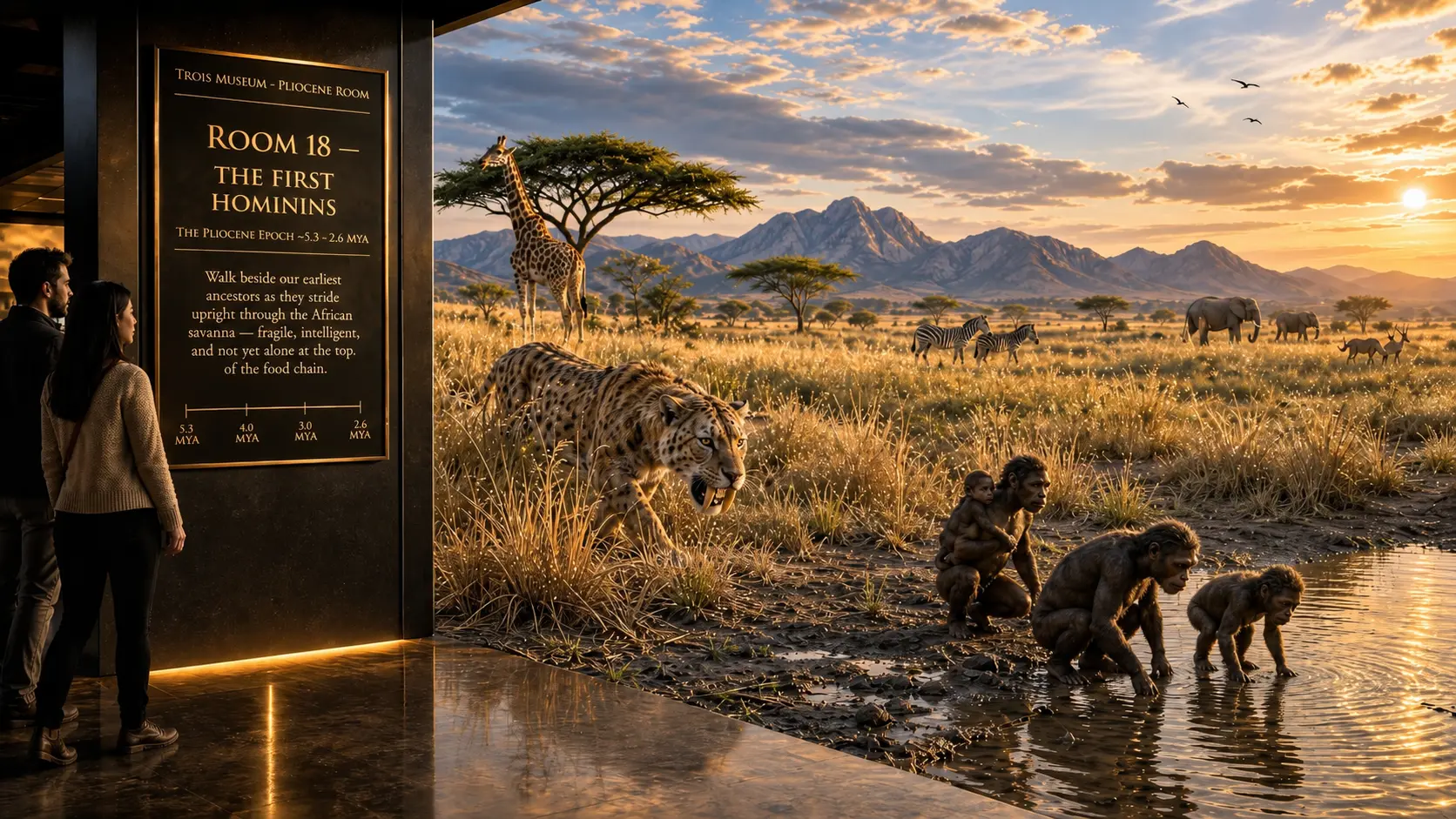
The First Hominins
The Pliocene Epoch · 5.3 – 2.6 m.y.a.
Australopithecus walks upright — pressing the first hominin footprints into volcanic ash. The earliest stone tools appear. Fire is not yet mastered, but the path toward it is being walked. The long preparation for human consciousness is nearly complete.
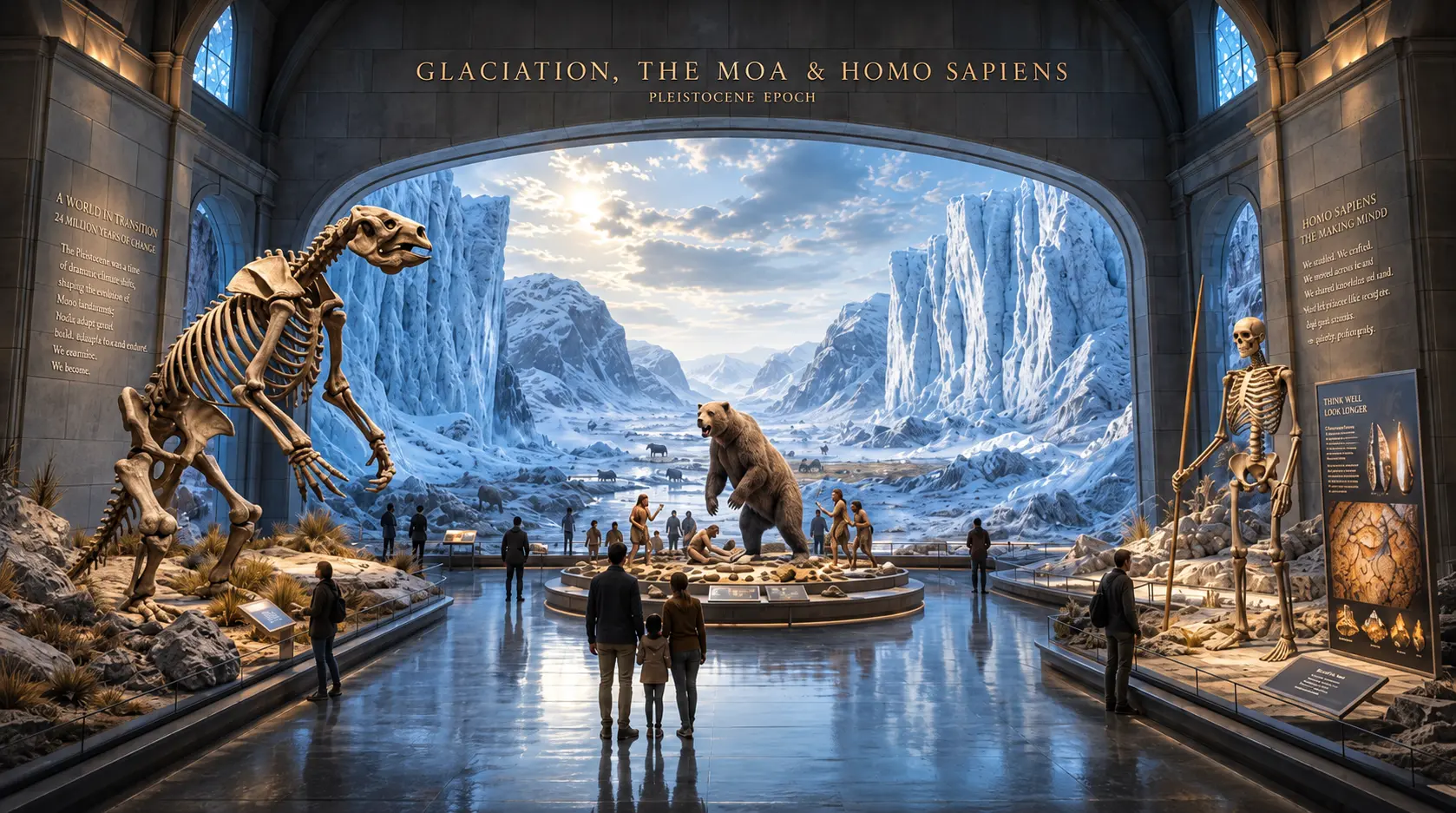
Glaciation & Homo Sapiens
The Pleistocene Epoch · 2.58 million – 11,700 y.a.
Ice ages sculpt the continents. Homo sapiens emerge in Africa, spread across every landmass, paint cave walls, bury their dead with care, and begin to speak. The questions begin.
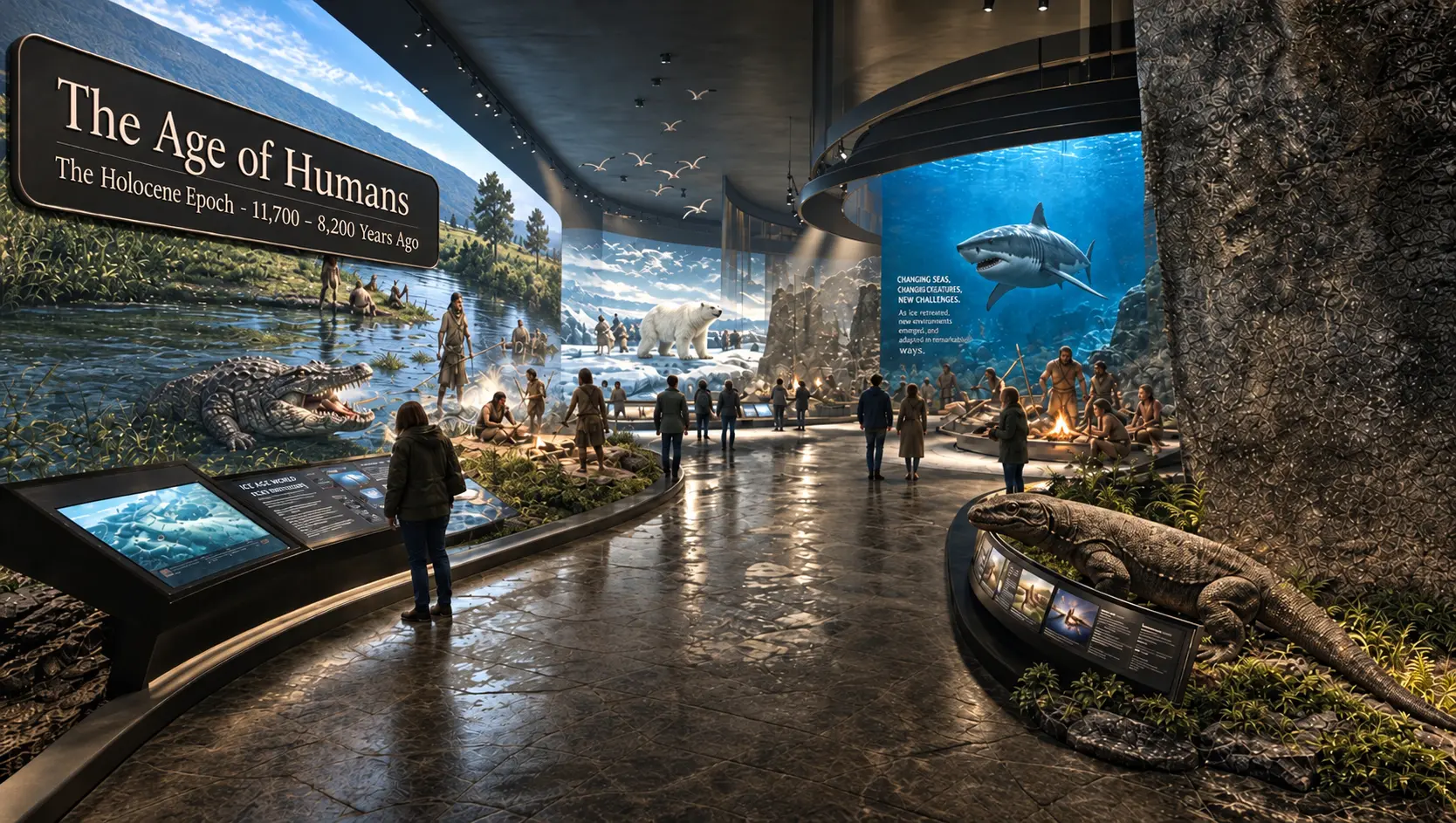
The Age of Humans
The Holocene Epoch · 11,700 Years Ago – Present
The ice retreats. The rivers settle. The world warms into the climate that humans will recognize as home. Wheat is planted. Cities rise. Writing is invented. Empires bloom and fall. Faiths are built and shared. The species that began as small, watchful primates becomes the species that paints, prays, builds, dreams, and remembers.
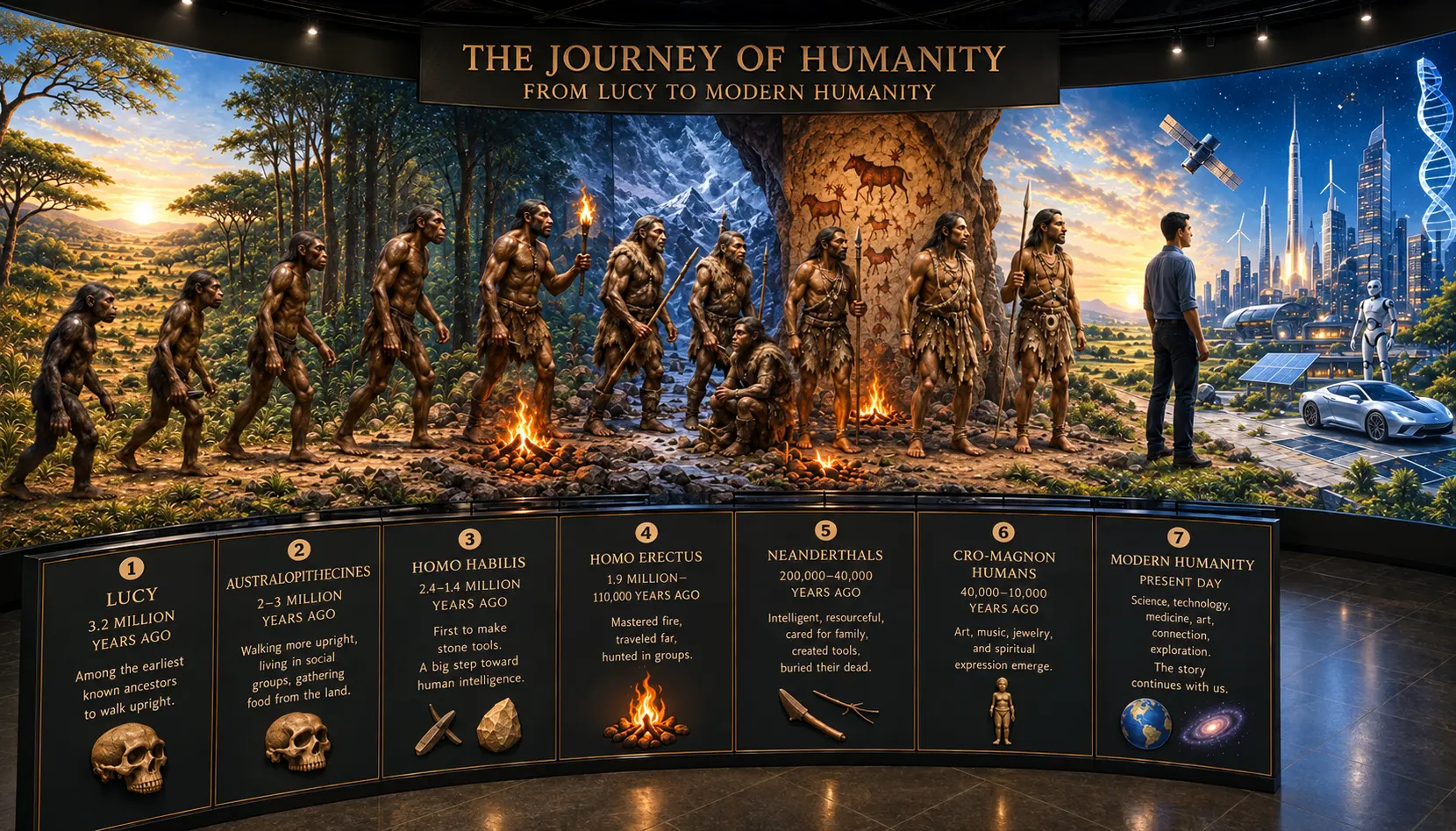
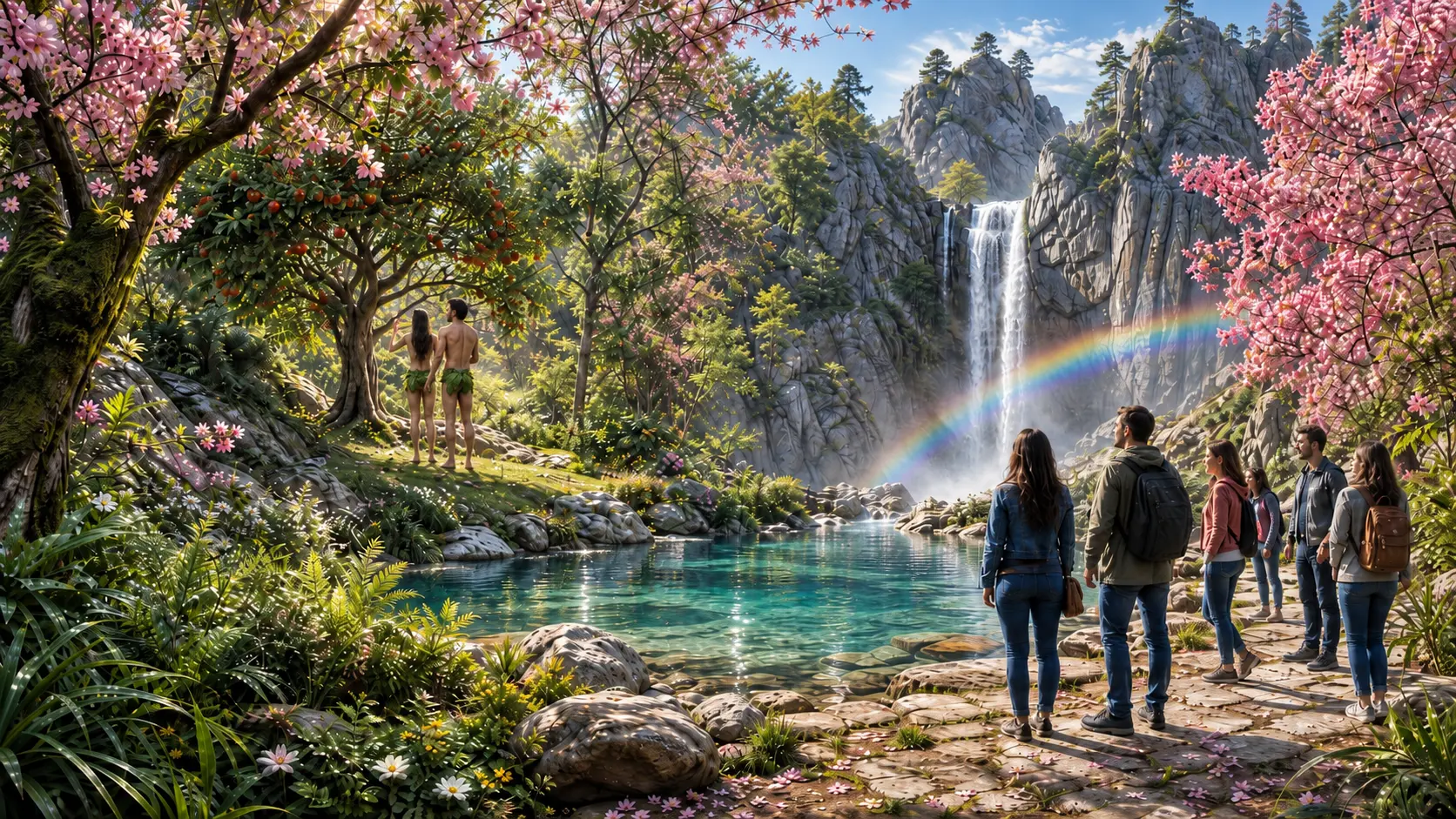
The Garden of Eden
The Dawn of Creation · c. 8,200 Years Ago
In the oldest stories of our kind, there was a garden — abundant, perfect, and lost. Across cultures and continents, humanity carries this memory of paradise: a time before toil, before separation from the wild, before the questions that define us. The Trois Museum honors these stories not as myth alone, but as the deep emotional truth of who we are and what we have always longed to return to.
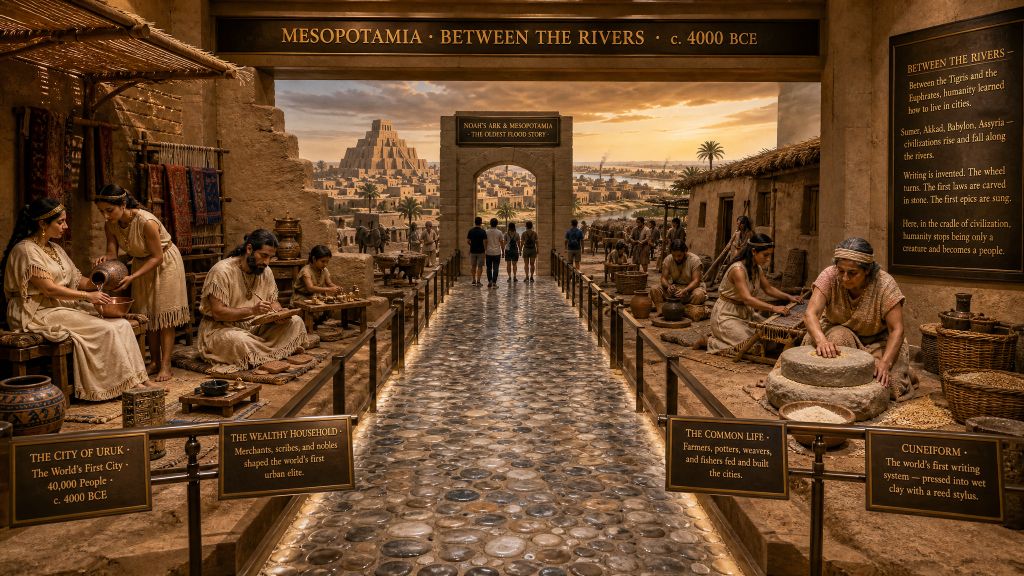
Mesopotamia
Between the Rivers · c. 4000 BCE
Between the Tigris and the Euphrates, humanity learned how to live in cities. The Sumerians, followed by Akkad, Babylon, and Assyria, rose and fell along the rivers. Writing is invented. The wheel turns. The first laws are carved in stone. The first epics are sung. Here, in the cradle of civilization, humanity stops being only a creature and becomes a people.
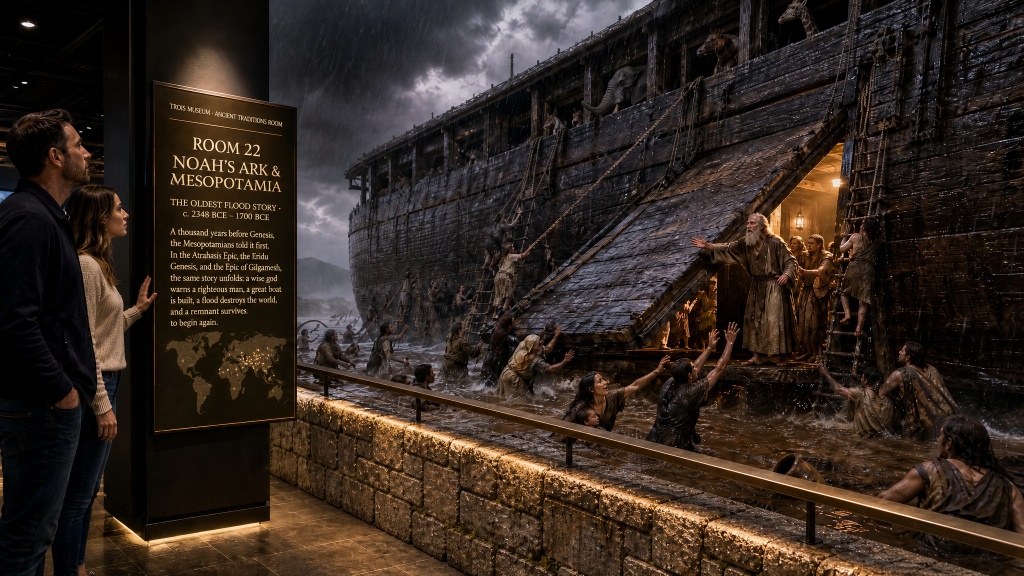
Noah's Ark
The Oldest Flood Story · c. 2348 BCE – 1700 BCE
A thousand years before Genesis, the Mesopotamians told it first. In the Atrahasis Epic, the Eridu Genesis, and the Epic of Gilgamesh, the same story unfolds: a wise god warns a righteous man, a great boat is built, a flood destroys the world, and a remnant survives to begin again. The Hebrew authors inherited the story and transformed it into the covenant we know. Whether literal or mythological, it marks a universal human memory of catastrophic renewal and the imperative to begin again. The museum holds the artifacts, the tablets, and the questions they still raise.
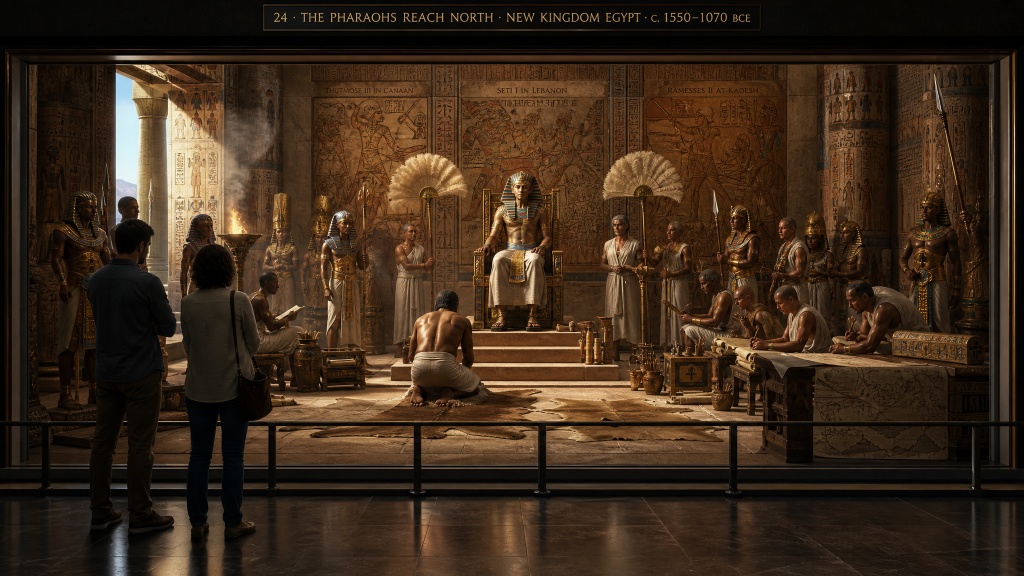
The Pharaohs Reach North
New Kingdom Egypt · c. 1550 – 1070 BCE
The chariots of Thutmose III thunder into Canaan. Seti I marches to the cedar forests of Lebanon. Ramesses II clashes with the Hittites at Kadesh in the largest chariot battle ever fought. For nearly five centuries, Egypt rules an empire stretching from Nubia to the Euphrates — administering vassal cities, garrisoning strongholds, and shaping the Bronze Age world. Then, with the great collapse of 1177 BCE, the empire falls. The template remains.
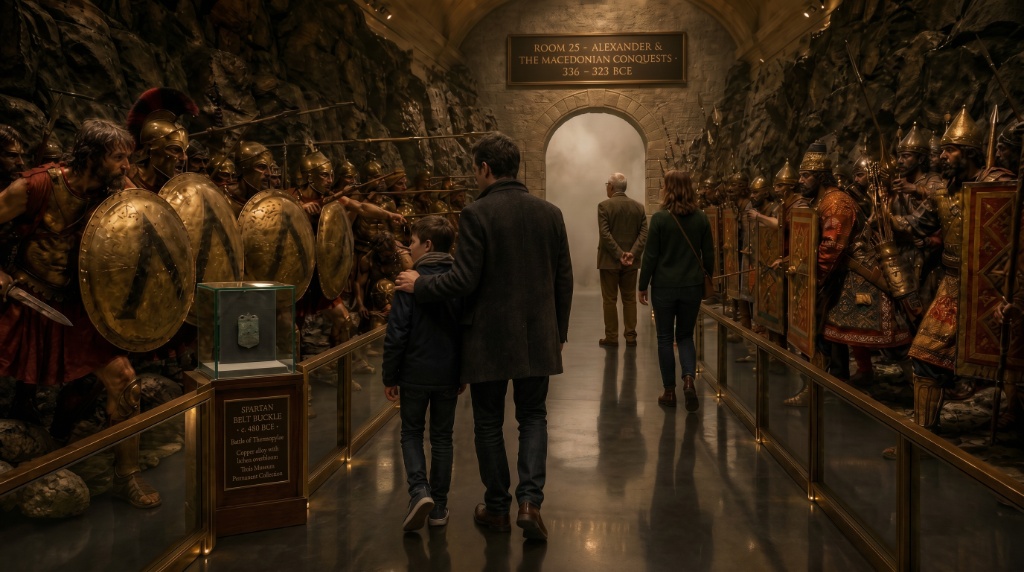
Persian–Greek Wars
499 – 449 BCE
At Marathon, Thermopylae, and Salamis, a collection of fractious Greek city-states holds back the largest empire the world had yet seen. The conflict produces democracy, philosophy, and theater — and the enduring myth that freedom is worth dying for. The museum asks what was actually at stake on both sides.
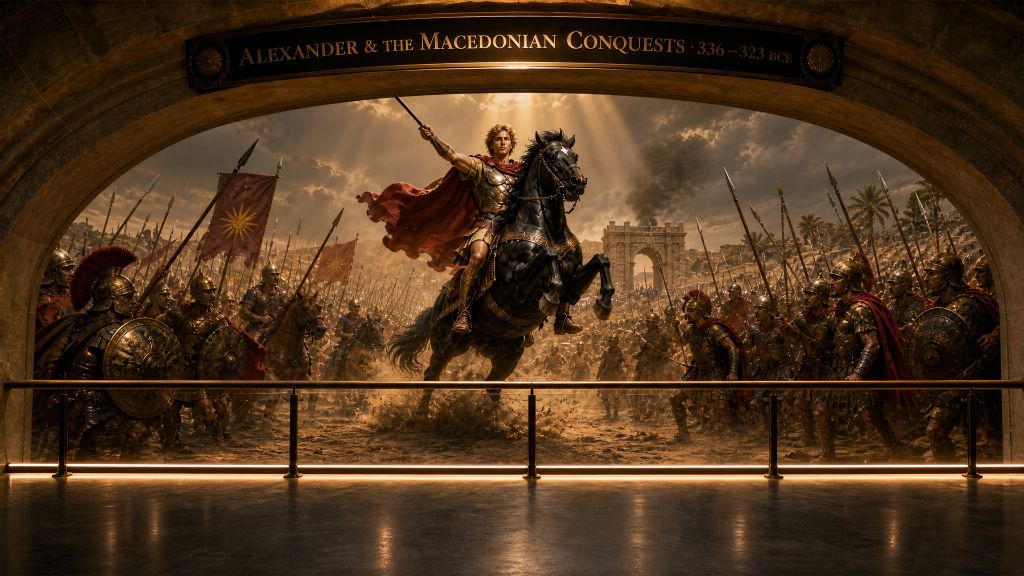
Alexander & the Macedonian Conquests
336 – 323 BCE
In just thirteen years, Alexander the Great crosses three continents from Macedonia to the Indus, founds as many as seventy cities, and fuses Greek, Persian, and Egyptian cultures into something the world had never seen. He dies at 32, leaving no chosen successor. His generals tear the empire apart — and the age of Hellenism begins.
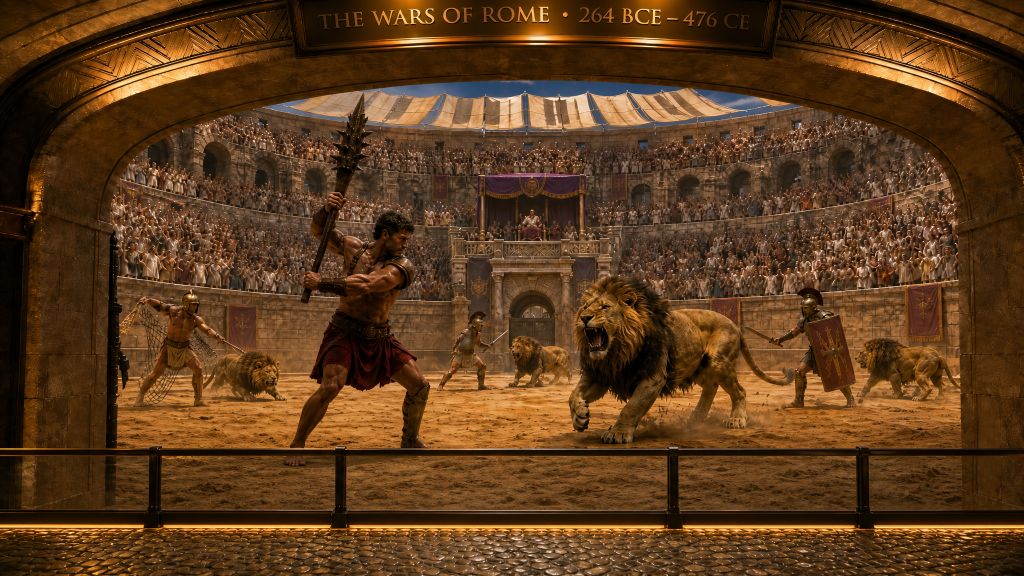
Wars of Rome
264 BCE – 476 CE
The Colosseum stands as Rome’s most enduring monument — a marvel of engineering where spectacle and death became civic ritual. Behind its arches lies the full Roman legacy: seven centuries of conquest from the Punic Wars to the fall of the Western Empire, codified law, roads, aqueducts, and a model of republican governance that would shape future constitutions — alongside slavery, genocide, and the calculated theater of human suffering.
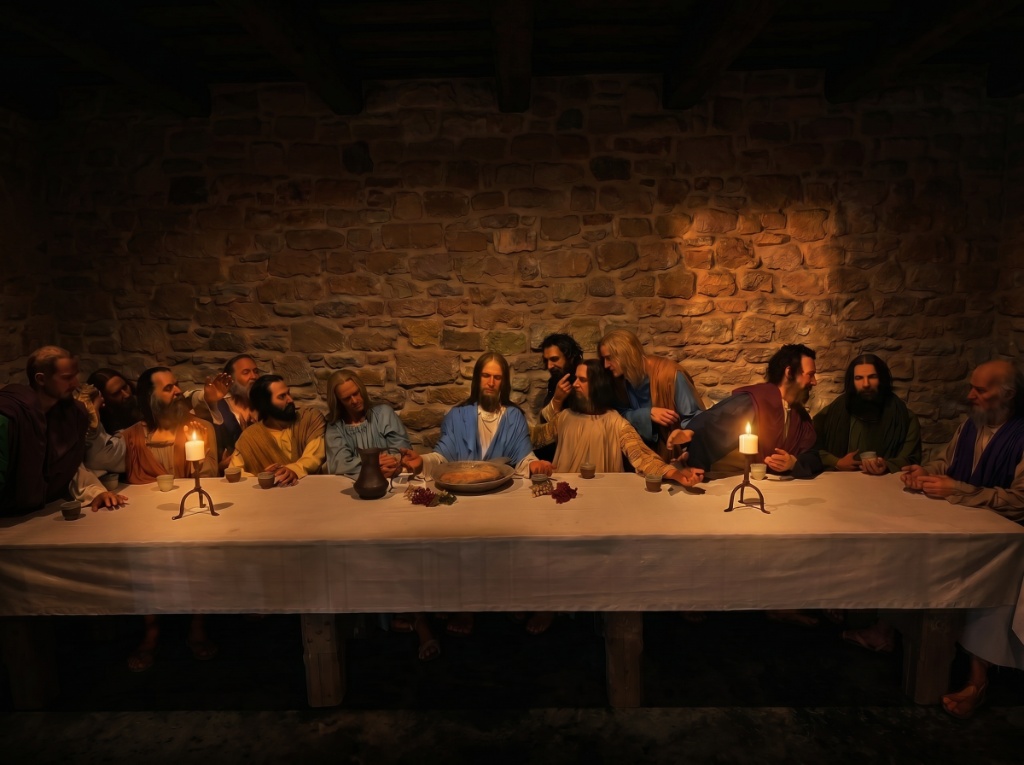
Christ & The Last Supper
First Century Jerusalem · c. 4 BCE – 33 CE
A carpenter's son from Nazareth spends three years teaching love, forgiveness, and the radical equality of every human soul — and changes the world more profoundly than any army ever has. At his final meal, he gathers twelve ordinary men around a table and asks them to remember him. Two thousand years later, the world still does. The museum's life-size waxwork recreation of that Last Supper invites every visitor — of every faith and none — to sit with the questions those thirteen men were asking: What do we owe each other? How should we live? What is worth dying for?
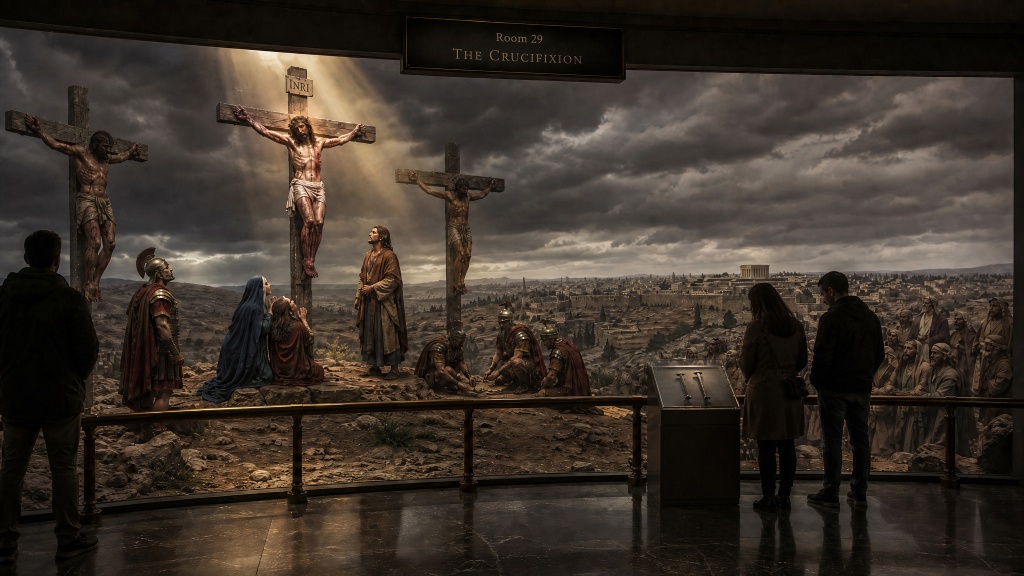
The Crucifixion
First Century Jerusalem · c. 4 BCE – 33 CE
In this solemn installation, visitors encounter the hour of Golgotha, where Jesus of Nazareth, suspended upon the cross, speaks words of mercy in the midst of suffering: “Father, forgive them.” Surrounded by mourners, soldiers, and a darkened sky, the scene reveals sacrifice, grief, and divine compassion with reverence, historical realism, and emotional power.
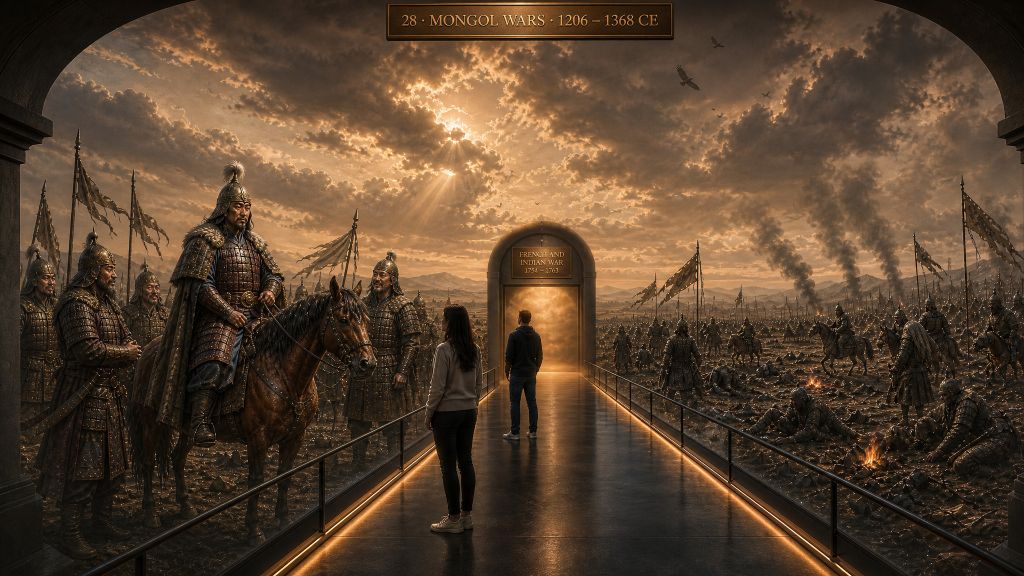
Mongol Wars
1206 – 1368 CE
Genghis Khan and his descendants build the largest contiguous land empire in human history — sacking Baghdad, razing Kiev, and killing tens of millions (some estimates reach 40 million). They also secure the Silk Road, accelerate the spread of the Black Death, and inadvertently connect East and West in ways that will reshape everything that follows.
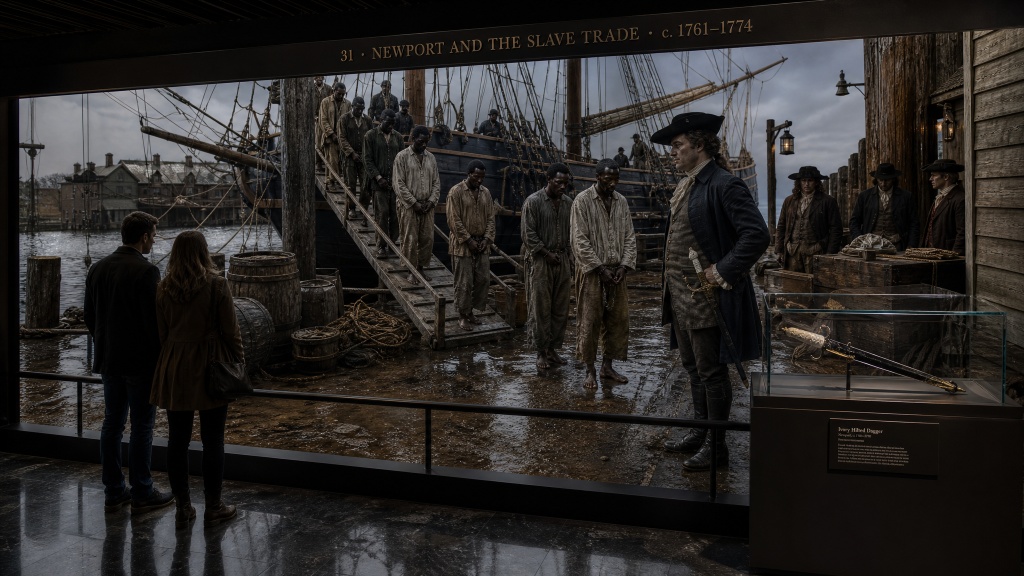
Newport and the Slave Trade
c. 1761 – 1774
Newport and the Slave Trade examines how wealth in colonial Newport was tied to human bondage. Centered on merchant Aaron Lopez and the harbor world that profited from trafficking enslaved Africans, the room confronts the cold mechanics of commerce, coercion, and suffering that shaped Rhode Island's role in the Atlantic slave trade.
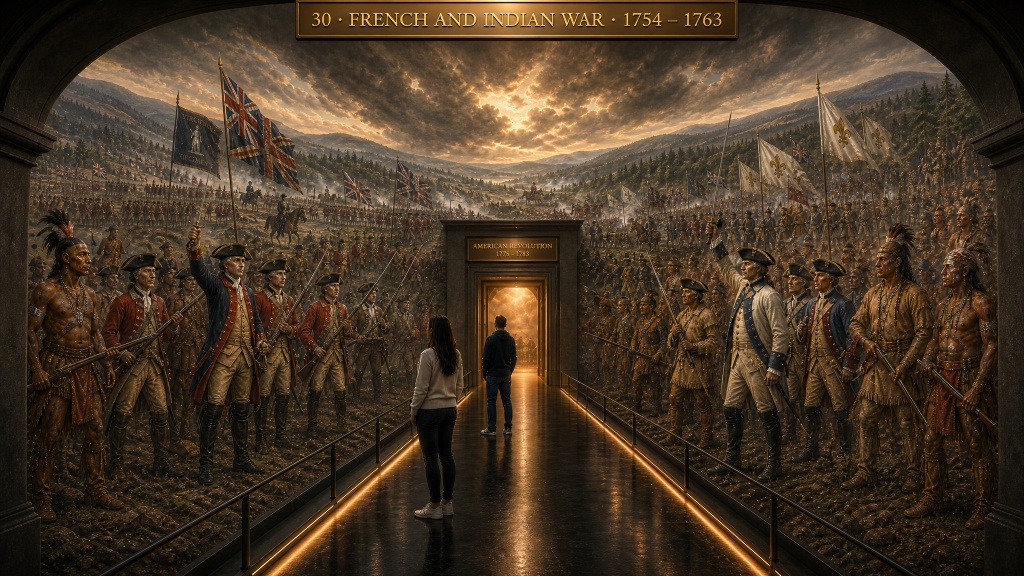
French & Indian War
1754 – 1763
A colonial skirmish in the forests of North America becomes the first true world war, fought simultaneously across five continents. Britain's victory bankrupts France — and Britain's attempt to tax the colonies to pay for it plants the seed of revolution that would change the world within a generation.
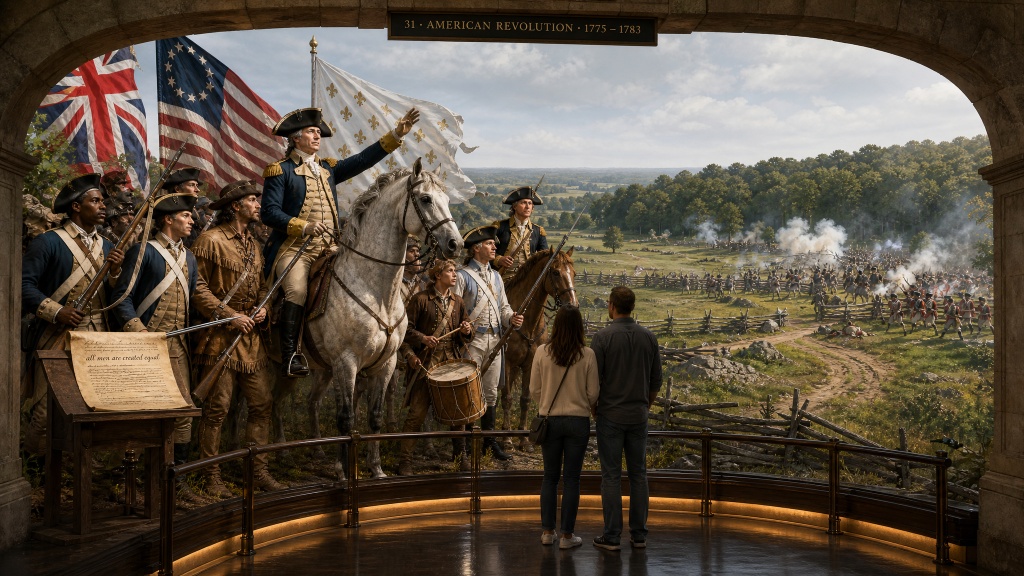
American Revolution
1775 – 1783
Thirteen colonies declare that all men are created equal — then fight an eight-year war to prove it. The contradiction between those words and the institution of slavery is built into the nation's founding document and deferred for nearly a century. The museum holds that tension honestly, without flinching.
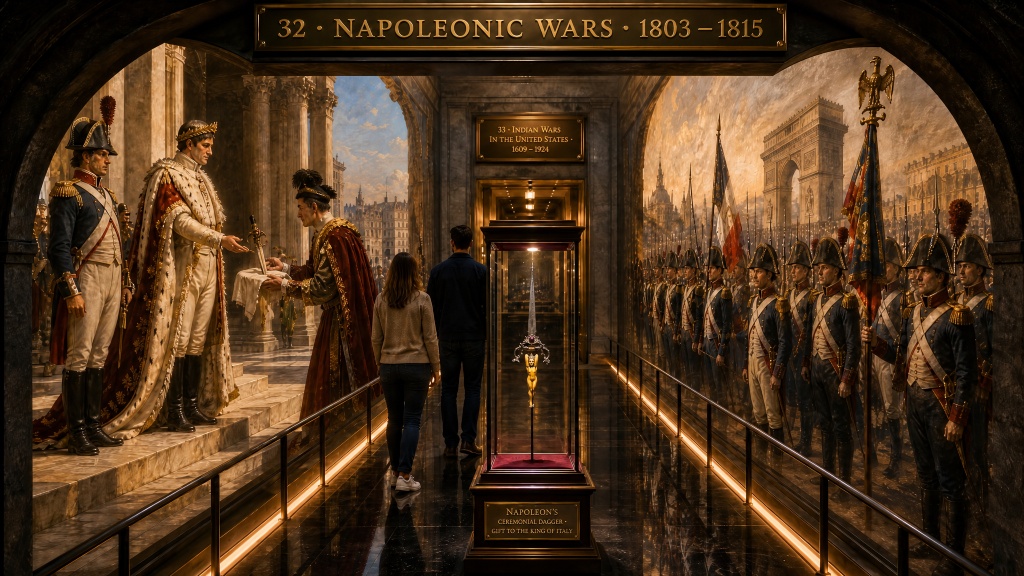
Napoleonic Wars
1803 – 1815
Napoleon Bonaparte reshapes Europe, spreads revolutionary ideals of liberty and nationalism across a continent, and then overreaches into Russia. His defeat at Waterloo triggers a century of relative peace among great powers — and establishes the modern nation-state as the dominant form of political organization.
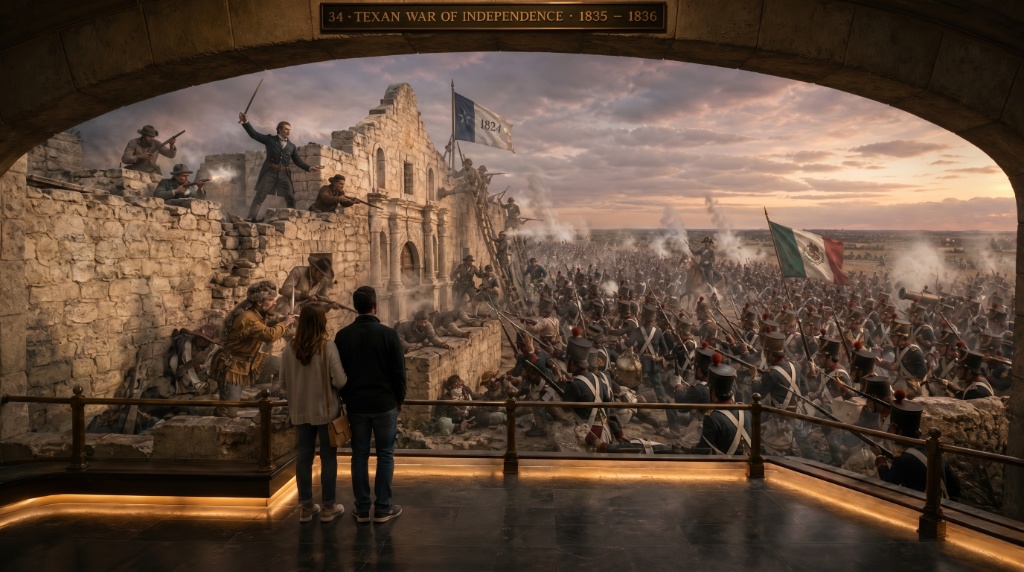
Texan War of Independence
1835 – 1836
A ragtag army of settlers, adventurers, and Tejano freedom fighters defeats the Mexican army and declares the Republic of Texas. The Alamo becomes a myth. But the war also accelerates the expansion of American slavery into new territories — and makes the Civil War nearly inevitable.
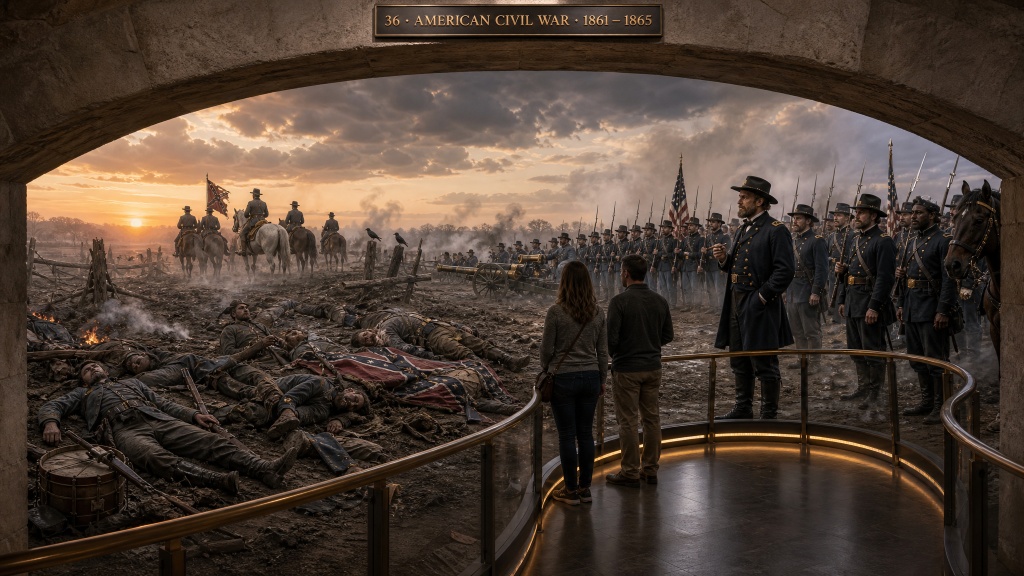
American Civil War
1861 – 1865
620,000 soldiers die in four years — more American casualties than all other wars combined. The nation tears itself apart over slavery, states' rights, and the meaning of the Declaration of Independence. The museum does not sanitize it: this was a war about human bondage, and the question it raised about equality is still being answered.
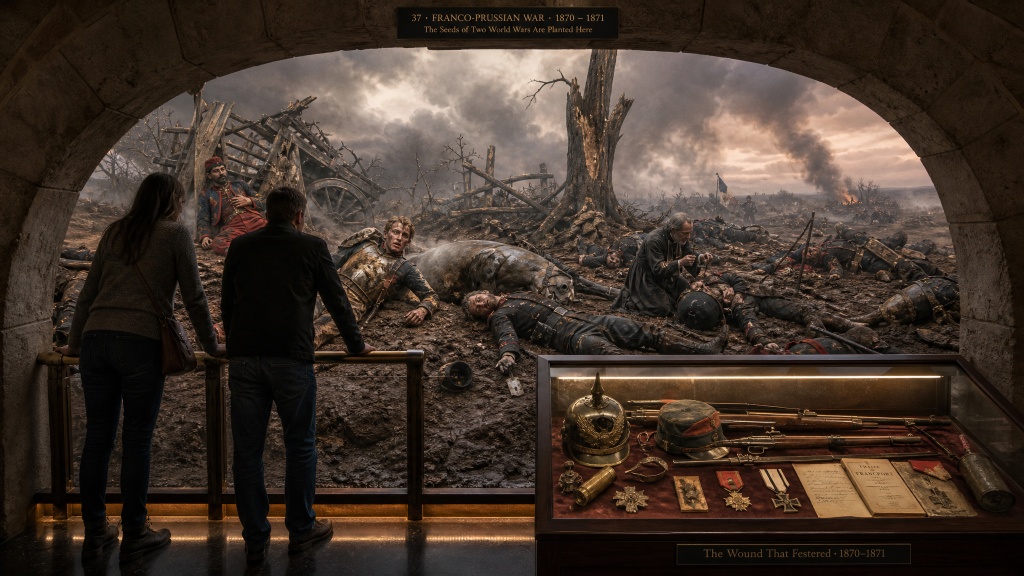
Franco-Prussian War
1870 – 1871
Prussia's lightning victory over France unifies the German states into a single empire — and humiliates France so deeply that the wound festers for forty-three years. The armistice terms signed in the Hall of Mirrors at Versailles are avenged in the same room in 1919. The seeds of both World Wars are planted here.
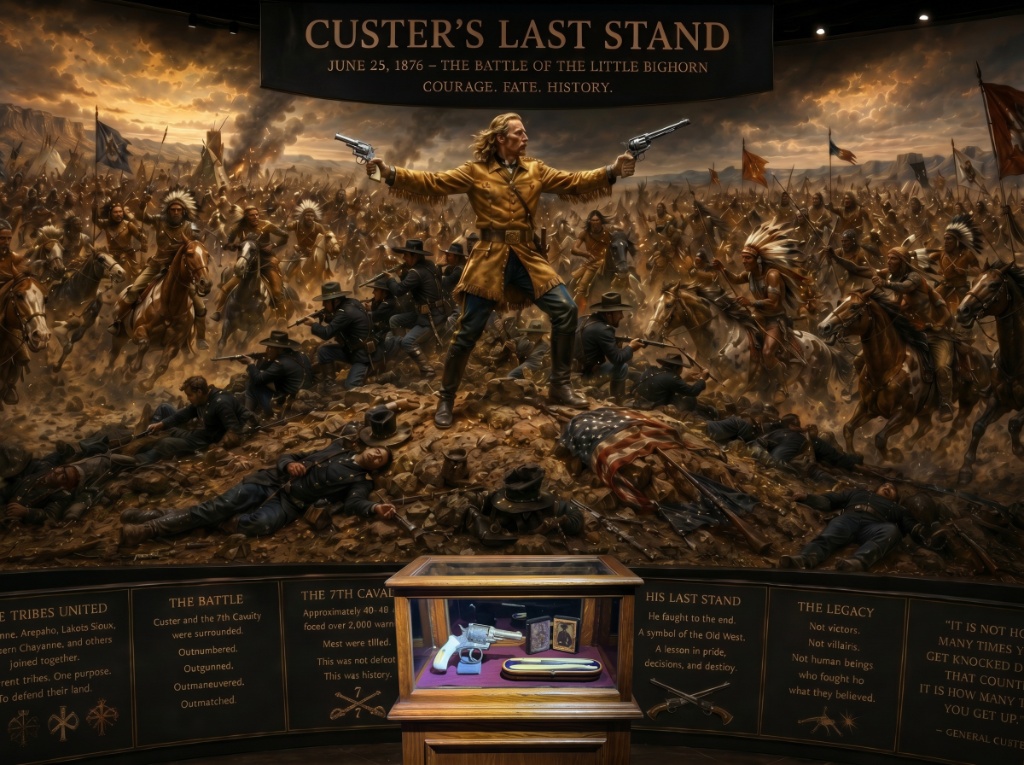
Indian Wars in the United States
1876
Over three centuries, the United States wages hundreds of campaigns against Indigenous nations — starting in 1609–1924, from Custer's Last Stand to forced assimilation — displacing peoples whose civilizations stretch back ten thousand years. The museum presents this history without euphemism: artifacts, treaties, broken promises, and cultures that endure.
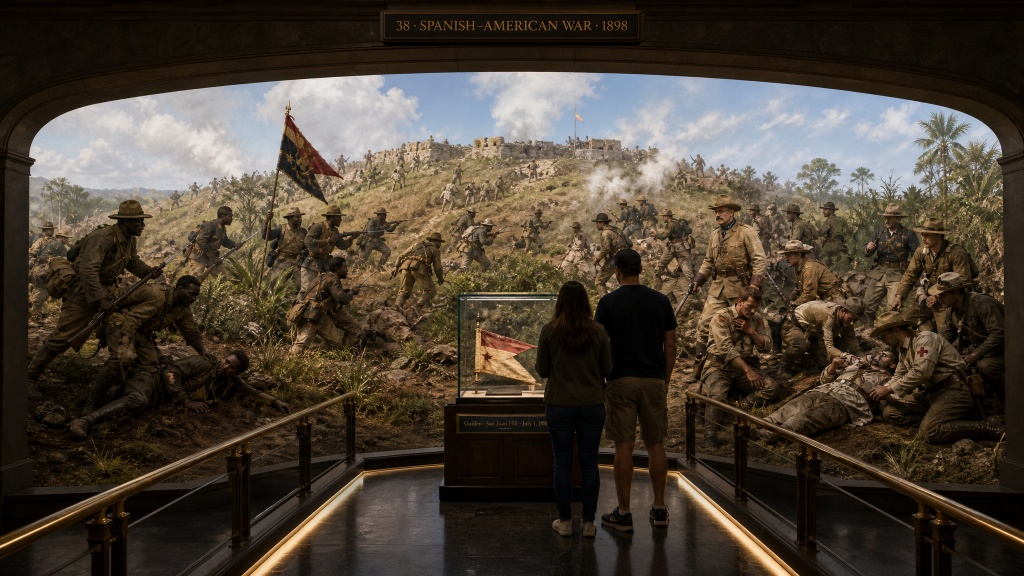
Spanish–American War
1898
A ten-week war ends Spain's five-century empire and launches the United States as a global military power. Cuba gains nominal independence. The Philippines, Guam, and Puerto Rico change hands. A new kind of imperialism — one that speaks the language of liberation — takes its first steps onto the world stage.
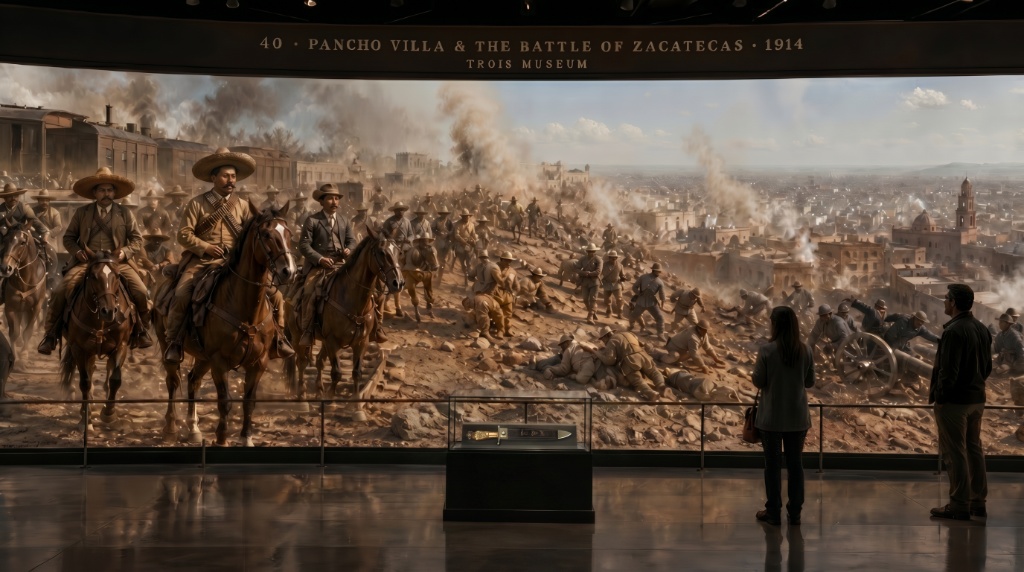
Pancho Villa & the Battle of Zacatecas
1914
In a cinematic museum tableau, mounted revolutionaries surge across a smoke-filled hillside as visitors face the violence and momentum of the Mexican Revolution. A small display case presents Villa’s dagger, linking the battlefield drama to a personal artifact of history.
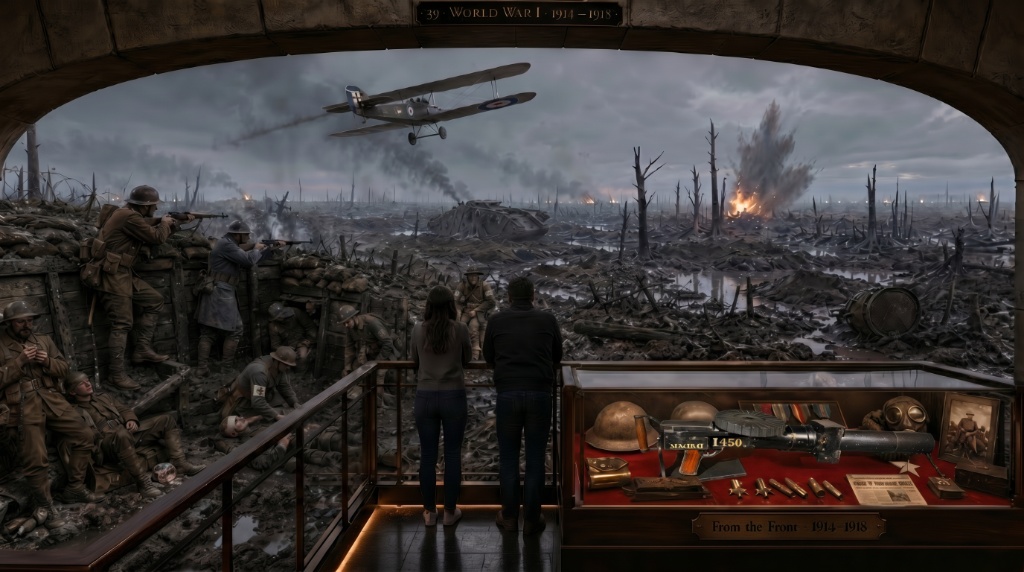
World War I
1914 – 1918
The Great War kills 20 million people in the mud of trenches that barely move for four years. Machine guns, poison gas, and industrial-scale slaughter render the old codes of honor obsolete. Empires collapse. Maps are redrawn. And the humiliating peace treaty plants the rage that becomes Adolf Hitler.
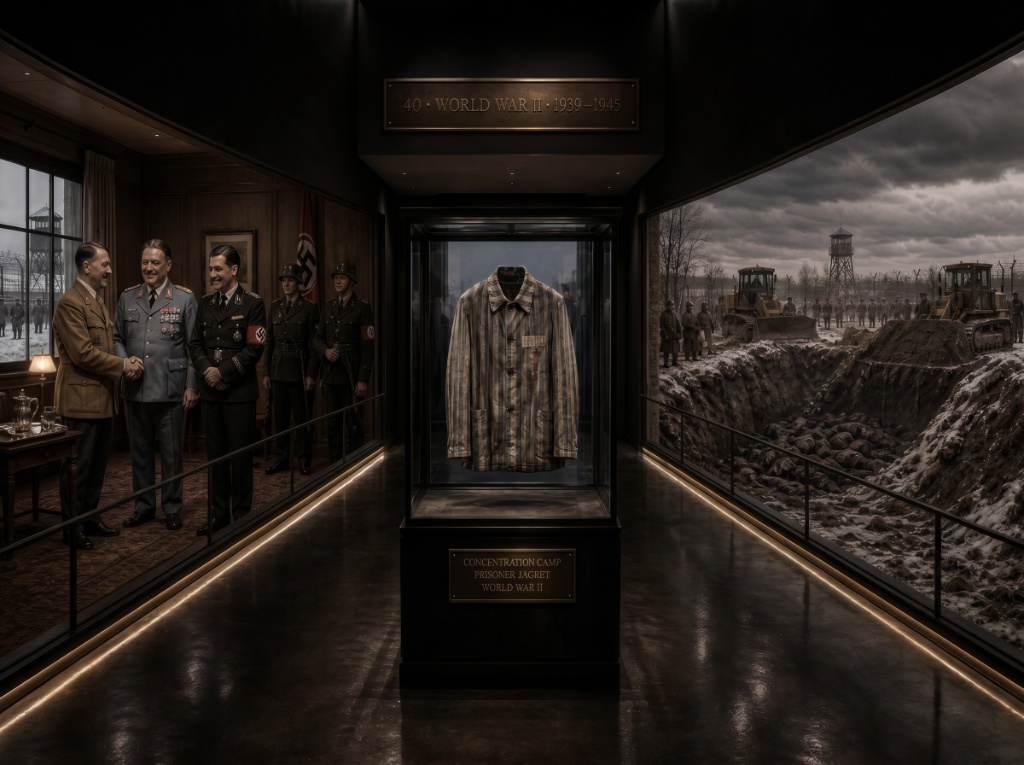
World War II
1939 – 1945
70 to 85 million dead. The Holocaust. The atomic bomb. The liberation of concentration camps. The fire-bombing of Dresden. The heroism of the French Resistance. The internment of Japanese Americans. This war holds within it nearly every question human beings have ever asked about good and evil, sacrifice and complicity.
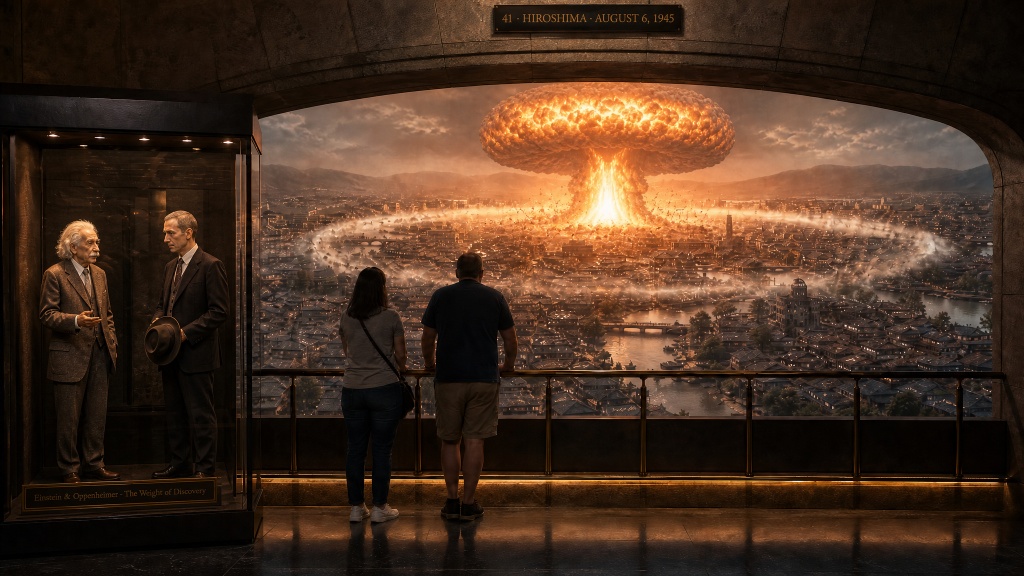
Hiroshima
August 6, 1945
The war ends here, at 8:15 in the morning. The visitor stands at an observation railing, looking down on the city in the instant of detonation — the fireball blooming, the mushroom cloud just rising, the shockwave a visible ring of compressed air racing outward across the rooftops. Buildings disintegrate in the light. Tiny figures run. World War II ends. The questions it raised do not.
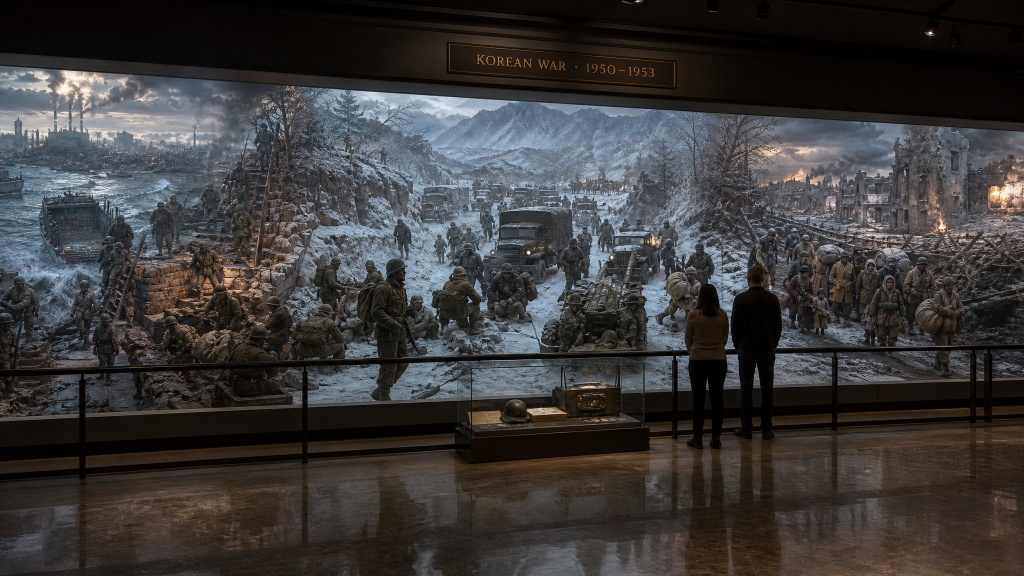
Korean War
1950 – 1953
Called the Forgotten War, it is anything but forgotten by the 36,000 Americans, 137,000 South Koreans, and nearly 3 million total combatants and civilians who died in it. The armistice signed in 1953 is still technically in effect. The Korean Peninsula remains divided. The war never officially ended.
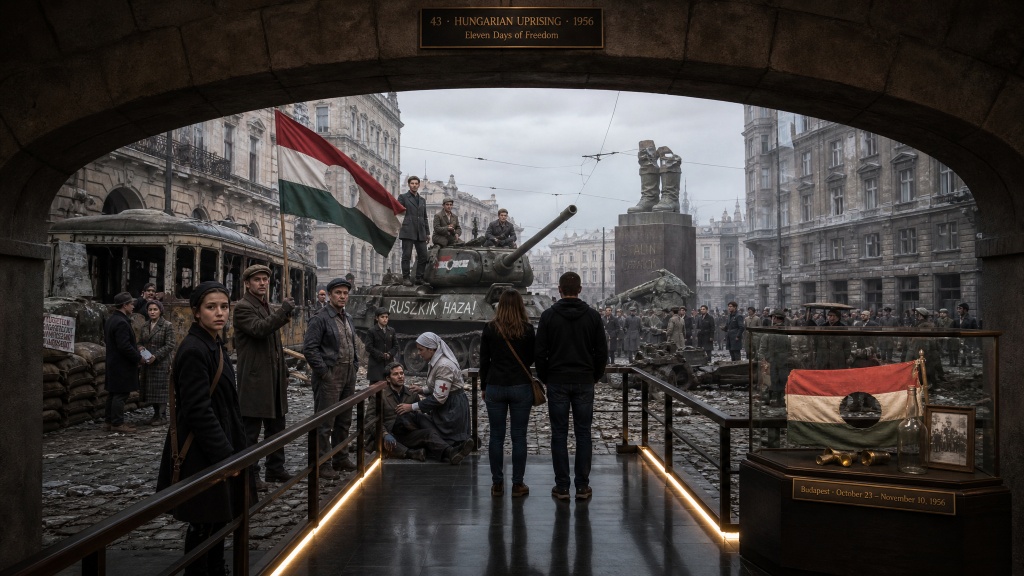
Hungarian Uprising
1956
Students and workers in Budapest rise against Soviet occupation in a spontaneous revolution — and for eleven days, they win. Then Soviet tanks roll in. The West watches and does nothing. 2,500 Hungarians die. 200,000 flee. The uprising becomes a defining symbol of the Cold War's brutal calculus of superpower interest over human freedom.
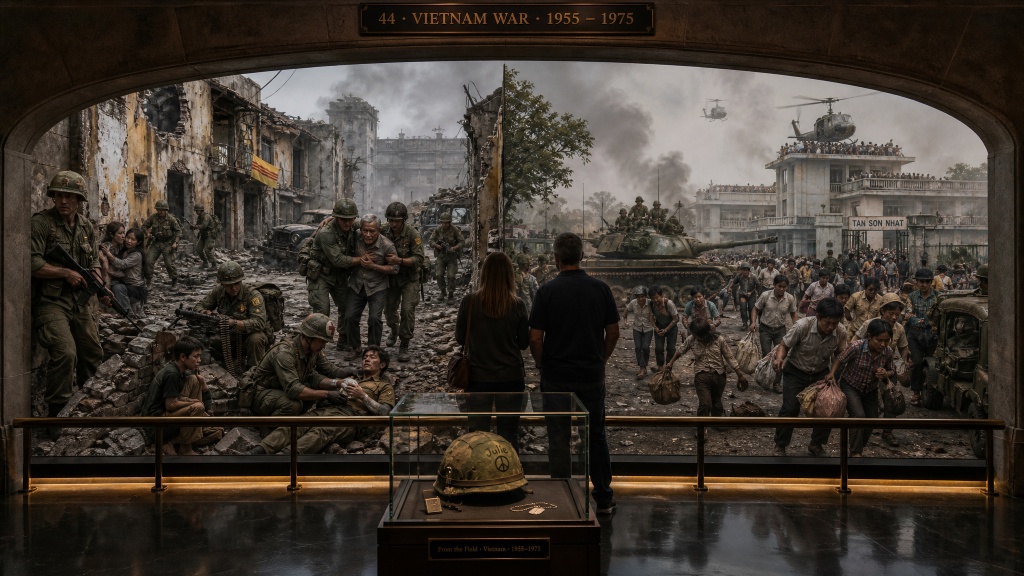
Vietnam War
1955 – 1975
58,000 Americans and 3 million Vietnamese die in a war the United States could not win and could not stop fighting. It tears American society apart — and forces a reckoning with the gap between what a nation says it stands for and what it actually does. That reckoning is still unfinished.
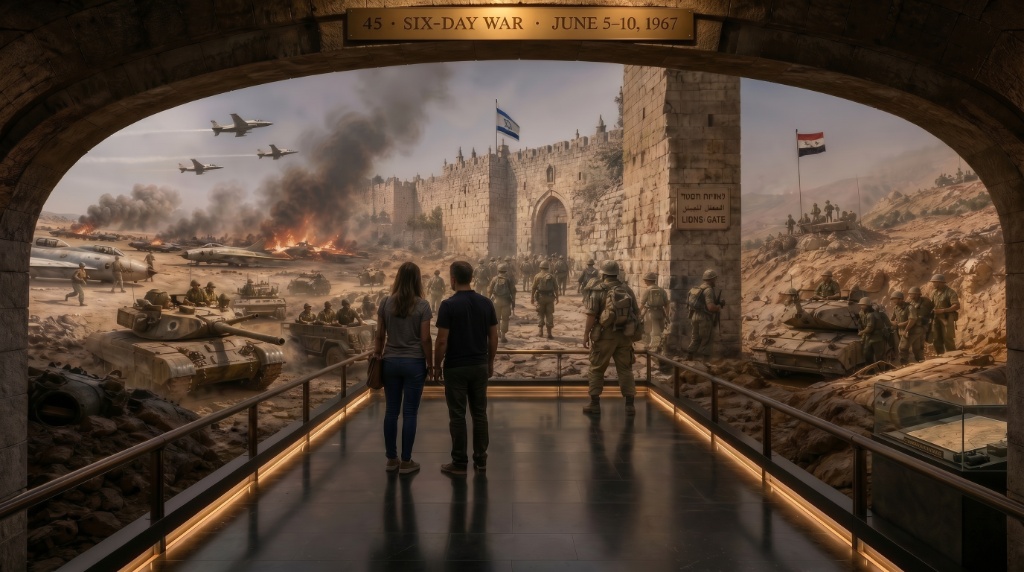
Six-Day War
June 5 – 10, 1967
In six days, Israel defeats Egypt, Jordan, and Syria simultaneously — capturing the Sinai, the West Bank, Gaza, and the Golan Heights. The war reshapes the Middle East in ways that reverberate through every subsequent decade. The territories captured are still disputed. The conflict it ignited has never ended.
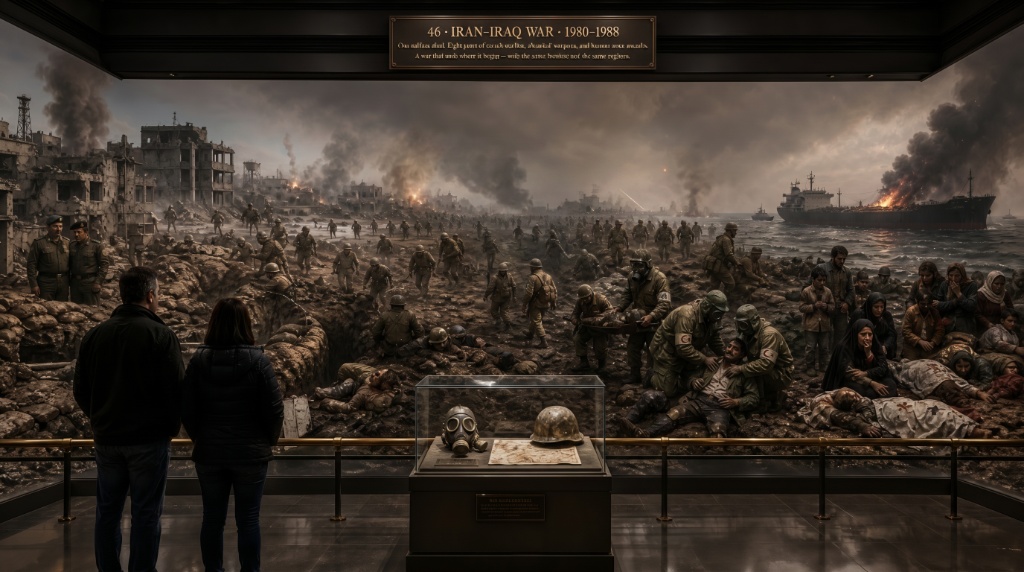
Iran–Iraq War
1980 – 1988
One million dead. Eight years of trench warfare, chemical weapons, and human wave assaults in a war that ends exactly where it began — with the same borders and the same regimes. The conflict destabilizes the Gulf, empowers extremism on both sides, and sets the stage for every Middle Eastern crisis that follows.
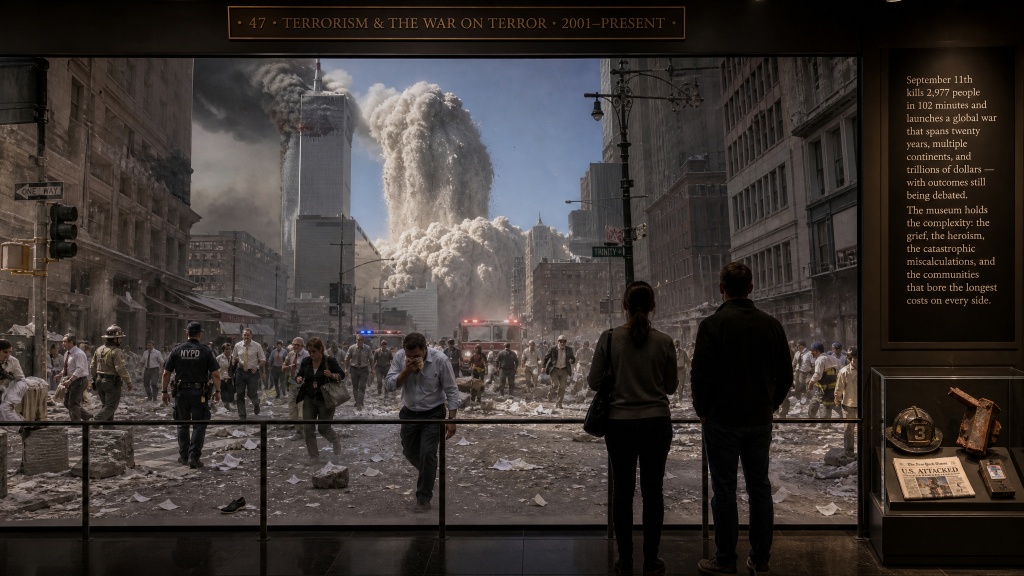
Terrorism & the War on Terror
2001 – Present
September 11th kills 2,977 people in 102 minutes and launches a global war that spans twenty years, multiple continents, and trillions of dollars — with outcomes still being debated. The museum holds the complexity: the grief, the heroism, the catastrophic miscalculations, and the communities that bore the longest costs on every side.
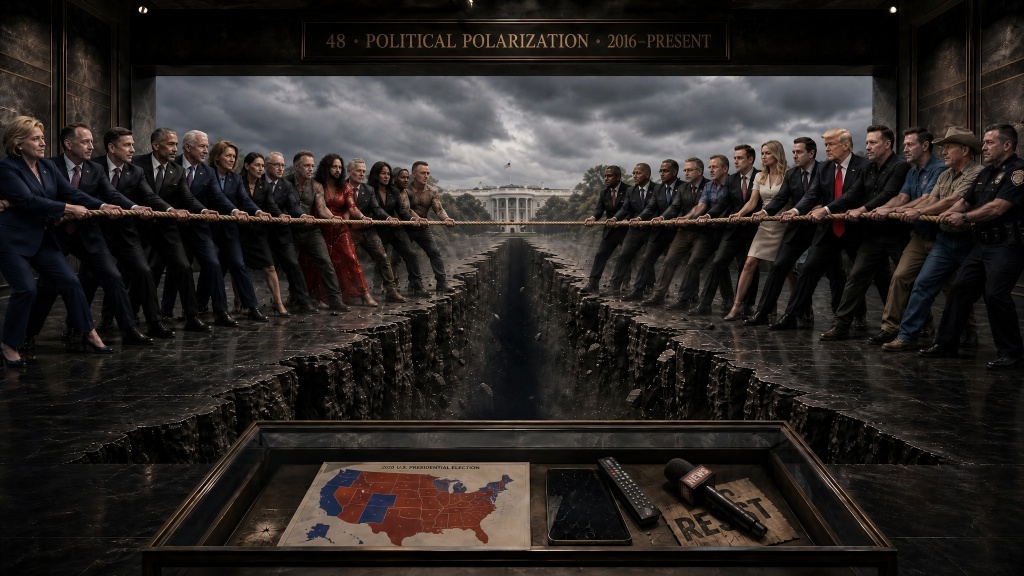
The Divide of the United States
2016 – Present
A nation that survived civil war, two world wars, and the Cold War finds itself fractured from within — by economic inequality, media fragmentation, racial reckoning, and a politics of mutual contempt. The museum does not take sides. It holds the mirror up. And it asks the same question it always asks: What do we owe each other?
The
Future
Now – Forward
This is the act with no ending written yet. Artificial intelligence. Climate change. The collapse and renewal of institutions. The possibility — still real — of choosing cooperation over catastrophe.
The museum ends here not with a conclusion, but with an open door.
You are standing at the threshold.
What happens next is yours to decide.
Tour the Collection — as It Stands Today
The museum isn’t a drawing. It’s here, in Texas, and it welcomes you. These three tours show what Charles and Rebecca have assembled across a lifetime — and what awaits visitors who come in person.
If a video does not load here, open the full tour in a new tab.
Begin a Private Conversation
“There are very few opportunities in a generation to help bring a major cultural institution into being — especially one rooted in such a singular private collection, such an ambitious architectural vision, and such a deep conviction that history, encountered honestly, can change us for the better.”
The Trois Museum welcomes many kinds of founding participation. Contributions may include financial gifts, land, materials, expertise, technology, planned giving, or strategic partnership. Every category of founding support leaves a permanent mark on the institution.
Call or text · All inquiries confidential · Private visits and video calls by appointment