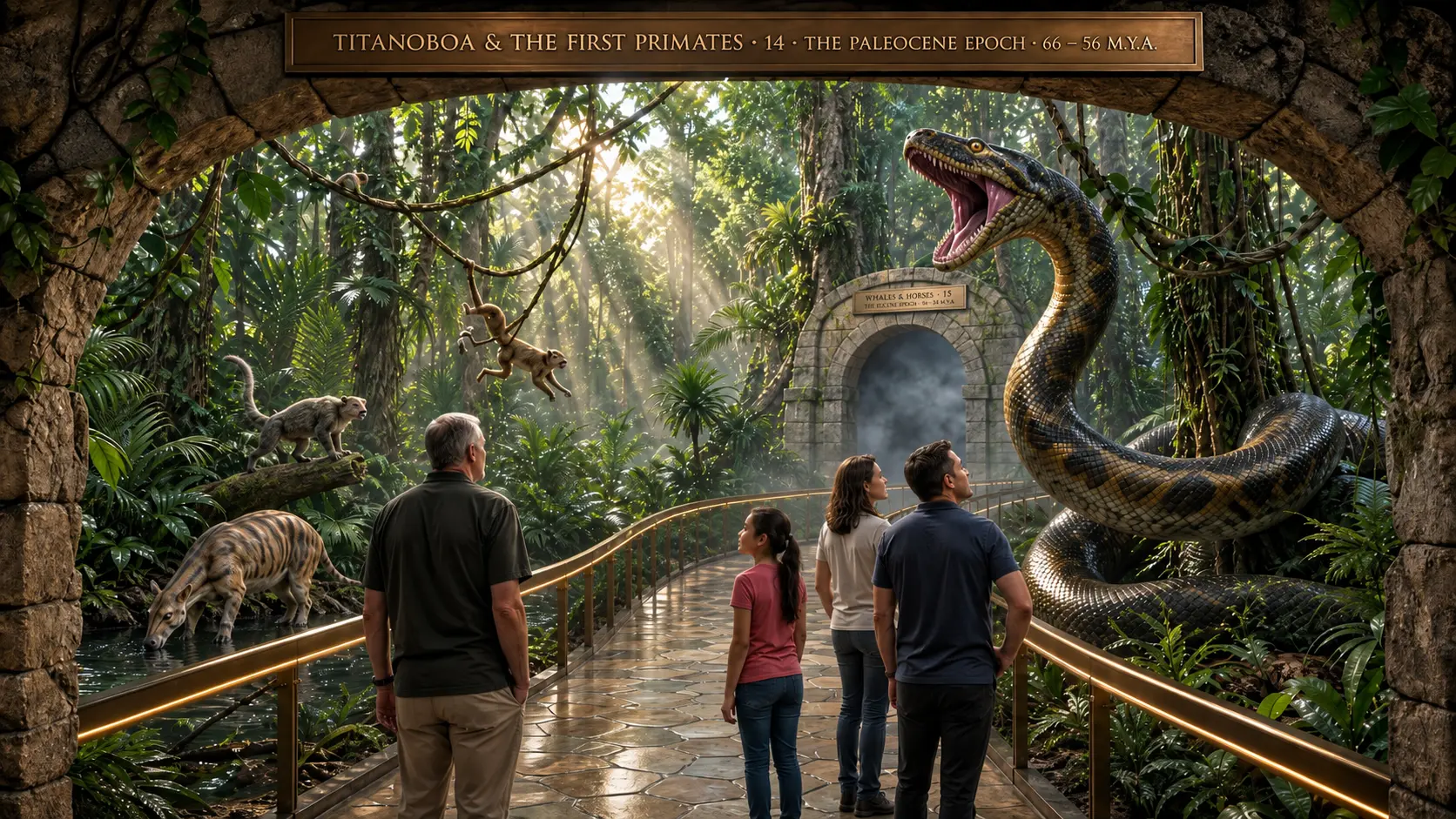
Titanoboa & the First Primates — Trois Museum concept visualization
Museum Tour / Titanoboa & the First Primates
Deep Time Spine

Titanoboa & the First Primates

The Paleocene Epoch · 66 – 56 m.y.a.

Working Concept Plan

The experience this room is designed to create

In the steaming rainforests after the asteroid, a 60-foot snake rules the jungle floor. Giant turtles drift through the rivers. Crocodile cousins prowl the swamps. And high in the canopy — small, intelligent, watchful — the primate branch takes its first tentative steps toward the creature that will one day ask: Why are we here?

Translate Titanoboa & the First Primates into a legible, embodied chapter of planetary history while keeping scientific evidence and visual reconstruction clearly distinguished.

Planning statusThis page is a directional design brief, not a finalized curatorial, architectural, or construction commitment. It will evolve through scholarly, community, accessibility, conservation, and design review.
Experience Framework

How the plan unfolds

01

Visitor journey

  • Approach through a threshold that establishes the time scale of The Paleocene Epoch · 66 – 56 m.y.a..
  • Encounter the central environmental change or living system at human scale.
  • Close with one clear consequence that carries visitors toward the next room.
02

Spatial & atmospheric plan

  • Use landscape-scale imagery, material samples, and directional sound without obscuring the evidence.
  • Balance cinematic immersion with readable labels, resting points, and a low-sensory route.
  • Keep the passage to the next room visible so the spine reads as one continuous story.
03

Interpretive commitments

  • Separate verified evidence, interpretation, and artistic reconstruction in the label hierarchy.
  • Review language and object context with relevant scholars and affected communities.
  • Provide captions, transcripts, tactile or descriptive alternatives, and a low-sensory path.
04

Next development priorities

  • Confirm the curatorial thesis and source packet.
  • Identify anchor objects, replicas, media, and rights requirements.
  • Prototype the central visitor encounter at full or representative scale.
  • Complete accessibility, conservation, safety, and ethical-display reviews.

Continue through the complete civilizational arc, or join the conversation shaping what these rooms become.