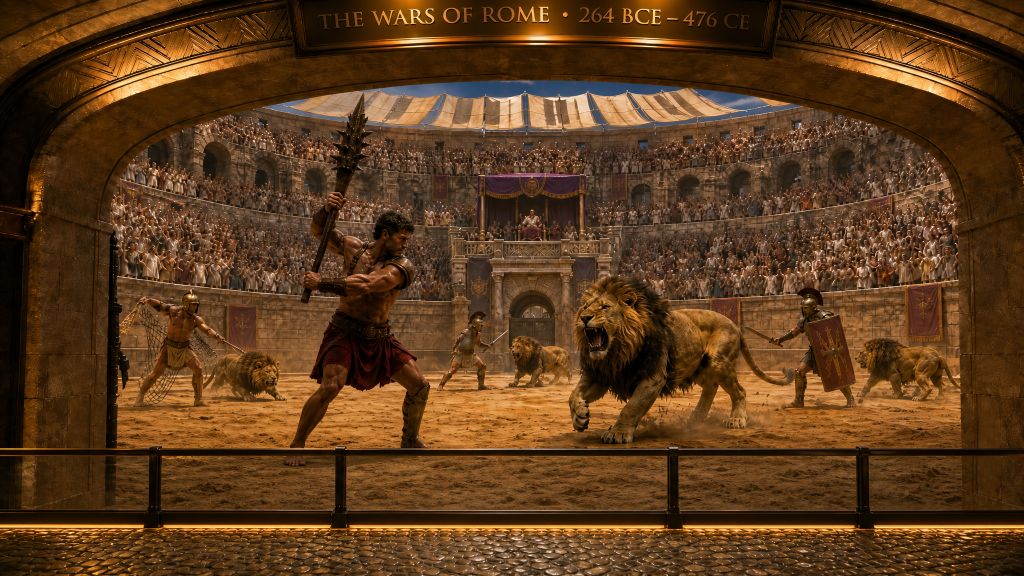
Wars of Rome — Trois Museum concept visualization
Museum Tour / Wars of Rome
Civilization, Belief & Memory

Wars of Rome

264 BCE – 476 CE

Working Concept Plan

The experience this room is designed to create

The Colosseum stands as Rome's most enduring monument — a marvel of engineering where spectacle and death became civic ritual. Behind its arches lies the full Roman legacy: seven centuries of conquest from the Punic Wars to the fall of the Western Empire, codified law, roads, aqueducts, and a model of republican governance that would shape future constitutions — alongside slavery, genocide, and the calculated theater of human suffering.

Frame Wars of Rome as a human story shaped by evidence, belief, place, and inherited memory rather than as a single unquestioned account.

Planning statusThis page is a directional design brief, not a finalized curatorial, architectural, or construction commitment. It will evolve through scholarly, community, accessibility, conservation, and design review.
Experience Framework

How the plan unfolds

01

Visitor journey

  • Enter through a geographic and chronological orientation point.
  • Meet the central objects, voices, or reconstructed scene with multiple levels of interpretation.
  • Leave with a question connecting the room’s legacy to the wider civilizational arc.
02

Spatial & atmospheric plan

  • Pair immersive reconstruction with clearly separated original material, facsimiles, and interpretive media.
  • Use intimate human-scale moments before revealing the wider historical setting.
  • Support contemplation and respectful circulation around culturally or spiritually sensitive material.
03

Interpretive commitments

  • Separate verified evidence, interpretation, and artistic reconstruction in the label hierarchy.
  • Review language and object context with relevant scholars and affected communities.
  • Provide captions, transcripts, tactile or descriptive alternatives, and a low-sensory path.
04

Next development priorities

  • Confirm the curatorial thesis and source packet.
  • Identify anchor objects, replicas, media, and rights requirements.
  • Prototype the central visitor encounter at full or representative scale.
  • Complete accessibility, conservation, safety, and ethical-display reviews.

Continue through the complete civilizational arc, or join the conversation shaping what these rooms become.