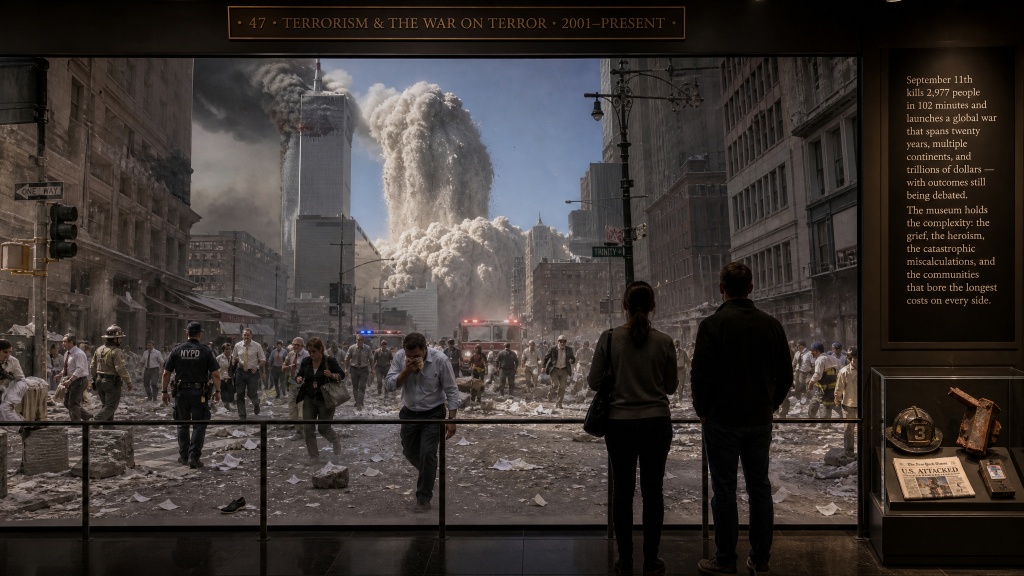
Terrorism & the War on Terror — Trois Museum concept visualization
Museum Tour / Terrorism & the War on Terror
Conflict, Power & Consequence

Terrorism & the War on Terror

2001 – Present

Working Concept Plan

The experience this room is designed to create

September 11th kills 2,977 people in 102 minutes and launches a global war that spans twenty years, multiple continents, and trillions of dollars — with outcomes still being debated. The museum holds the complexity: the grief, the heroism, the catastrophic miscalculations, and the communities that bore the longest costs on every side.

Present Terrorism & the War on Terror with historical clarity, human dignity, and enough context to understand causes, choices, consequences, and contested memory.

Planning statusThis page is a directional design brief, not a finalized curatorial, architectural, or construction commitment. It will evolve through scholarly, community, accessibility, conservation, and design review.
Experience Framework

How the plan unfolds

01

Visitor journey

  • Orient visitors before the conflict through maps, timelines, and the voices of people who lived through it.
  • Build toward one central encounter without aestheticizing suffering.
  • Provide a decompression point focused on aftermath, memory, and the choices carried forward.
02

Spatial & atmospheric plan

  • Separate orientation, encounter, evidence, and reflection zones.
  • Use sound and motion sparingly, with visible content guidance and an alternate route.
  • Prioritize first-person testimony and artifact context over spectacle.
03

Interpretive commitments

  • Separate verified evidence, interpretation, and artistic reconstruction in the label hierarchy.
  • Review language and object context with relevant scholars and affected communities.
  • Provide captions, transcripts, tactile or descriptive alternatives, and a low-sensory path.
04

Next development priorities

  • Confirm the curatorial thesis and source packet.
  • Identify anchor objects, replicas, media, and rights requirements.
  • Prototype the central visitor encounter at full or representative scale.
  • Complete accessibility, conservation, safety, and ethical-display reviews.

Continue through the complete civilizational arc, or join the conversation shaping what these rooms become.