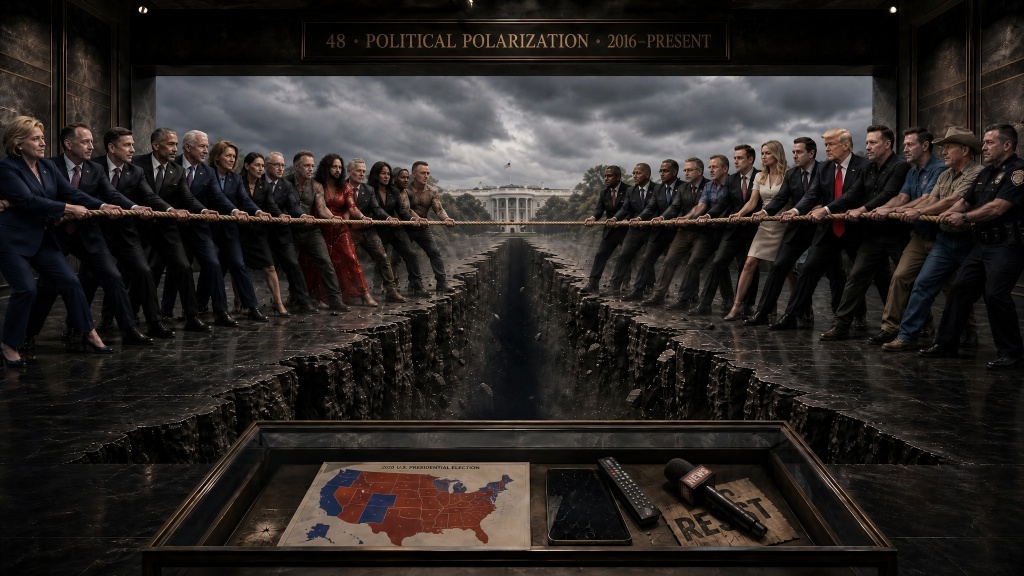
The Divide of the United States — Trois Museum concept visualization
Museum Tour / The Divide of the United States
Conflict, Power & Consequence

The Divide of the United States

2016 – Present

Working Concept Plan

The experience this room is designed to create

A nation that survived civil war, two world wars, and the Cold War finds itself fractured from within — by economic inequality, media fragmentation, racial reckoning, and a politics of mutual contempt. The museum does not take sides. It holds the mirror up. And it asks the same question it always asks: What do we owe each other?

Present The Divide of the United States with historical clarity, human dignity, and enough context to understand causes, choices, consequences, and contested memory.

Planning statusThis page is a directional design brief, not a finalized curatorial, architectural, or construction commitment. It will evolve through scholarly, community, accessibility, conservation, and design review.
Experience Framework

How the plan unfolds

01

Visitor journey

  • Orient visitors before the conflict through maps, timelines, and the voices of people who lived through it.
  • Build toward one central encounter without aestheticizing suffering.
  • Provide a decompression point focused on aftermath, memory, and the choices carried forward.
02

Spatial & atmospheric plan

  • Separate orientation, encounter, evidence, and reflection zones.
  • Use sound and motion sparingly, with visible content guidance and an alternate route.
  • Prioritize first-person testimony and artifact context over spectacle.
03

Interpretive commitments

  • Separate verified evidence, interpretation, and artistic reconstruction in the label hierarchy.
  • Review language and object context with relevant scholars and affected communities.
  • Provide captions, transcripts, tactile or descriptive alternatives, and a low-sensory path.
04

Next development priorities

  • Confirm the curatorial thesis and source packet.
  • Identify anchor objects, replicas, media, and rights requirements.
  • Prototype the central visitor encounter at full or representative scale.
  • Complete accessibility, conservation, safety, and ethical-display reviews.

Continue through the complete civilizational arc, or join the conversation shaping what these rooms become.